Wednesday, February 26, 2014

Piaget's stages of Intellectual development

Piaget’s Stages of Cognitive Development

Sensory Motor Period (0 – 24 months)

Stage-Age     Characteristic Behavior
Reflexive Stage
(0-2 months)
Simple reflex activity such as grasping, sucking.
Primary Circular Reactions(2-4 months)Reflexive behaviors occur in stereotyped repetition such as opening and closing fingers repetitively.
Secondary Circular Reactions
(4-8 months)
Repetition of change actions to reproduce interesting consequences such as kicking one’s feet to more a mobile suspended over the crib.
Coordination of Secondary Reactions
(8-12 months)
Responses become coordinated into more complex sequences. Actions take on an “intentional” character such as the infant reaches behind a screen to obtain a hidden object.
Tertiary Circular Reactions
(12-18 months)
Discovery of new ways to produce the same consequence or obtain the same goal such as the infant may pull a pillow toward him in an attempt to get a toy resting on it.
Invention of New Means Through Mental Combination
(18-24 months)
Evidence of an internal representational system. Symbolizing the problem-solving sequence before actually responding. Deferred imitation.

The Preoperational Period (2-7 years)

Stage-AgeCharacteristic Behavior
Preoperational Phase
(2-4 years)
Increased use of verbal representation but speech is egocentric. The beginnings of symbolic rather than simple motor play. Transductive reasoning. Can think about something without the object being present by use of language.
Intuitive Phase
(4-7 years)
Speech becomes more social, less egocentric. The child has an intuitive grasp of logical concepts in some areas. However, there is still a tendency to focus attention on one aspect of an object while ignoring others. Concepts formed are crude and irreversible. Easy to believe in magical increase, decrease, disappearance. Reality not firm. Perceptions dominate judgment.In moral-ethical realm, the child is not able to show principles underlying best behavior. Rules of a game not develop, only uses simple do’s and don’ts imposed by authority.

Period of Concrete Operations (7-12 years)

Characteristic Behavior:
Evidence for organized, logical thought. There is the ability to perform multiple classification tasks, order objects in a logical sequence, and comprehend the principle of conservation. thinking becomes less transductive and less egocentric. The child is capable of concrete problem-solving.
Some reversibility now possible (quantities moved can be restored such as in arithmetic:
3+4 = 7 and 7-4 = 3, etc.)
Class logic-finding bases to sort unlike objects into logical groups where previously it was on superficial perceived attribute such as color. Categorical labels such as “number” or animal” now available.

Period of Formal Operations (12 years and onwards)

Characteristic Behavior:
Thought becomes more abstract, incorporating the principles of formal logic. The ability to generate abstract propositions, multiple hypotheses and their possible outcomes is evident. Thinking becomes less tied to concrete reality.
Formal logical systems can be acquired. Can handle proportions, algebraic manipulation, other purely abstract processes. If a + b = x then a = x – b. If ma/ca = IQ = 1.00 then Ma = CA.
Prepositional logic, as-if and if-then steps. Can use aids such as axioms to transcend human

Saturday, February 15, 2014

Basic Statistics


DESCRIPTIVE STATISTICS

 Statistics used to describe the pattern of data. It includes central tendency (mean, median mode), variability (Range, SD, Variance, Skewness, Kurtosis), frequency and percentage distribution.

Correlation: It is the linear relation between the variables. r is the index of correlation. It indicates strength and direction of relation. Direction is indicated by the sign advanced of r. There are few assumptions of r.

a)  The correlation coefficient assumes that the two variables measured
form a bivariate normal distribution population.
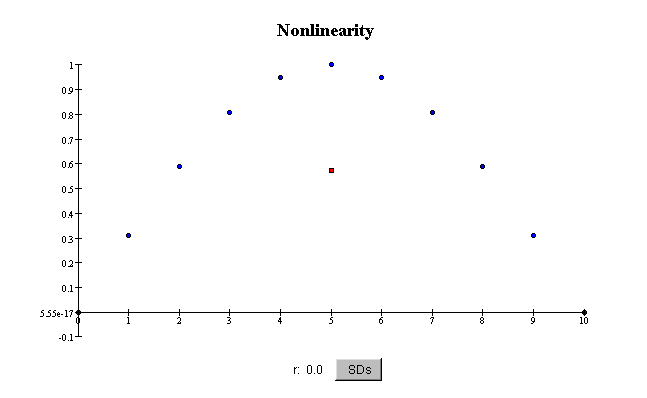
b) Correlation does not measure nonlinear association, only linear association. The correlation coefficient is appropriate only for quantitative variables, not ordinal or categorical variables, even if their values are numerical.
c)Correlation is a measure of association, not causation
d) Scatterplot or scatter diagram: The correlation coefficient r is close to 1 if the data cluster tightly around a straight line that slopes up from left to right. The correlation coefficient is close to -1 if the data cluster tightly around a straight line that slopes down from left to right. If the data do not cluster around a straight line, the correlation coefficient r is close to zero, even if the variables have a strong nonlinear association. 
e) Some scatterplots show curved patterns. Such scatterplots are said to show nonlinear association between the two variables. The correlation coefficient does not reflect nonlinear relationships between variables, only linear ones. For example, even if the association is quite strong, if it is nonlinear, the correlation coefficient r can be small or zero.


f) The correlation coefficient r measures only linear associations: how nearly the data
falls on a straight lineIt is not a good summary of the association if the scatterplot has a nonlinear
(curved) pattern.

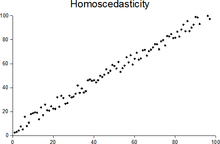
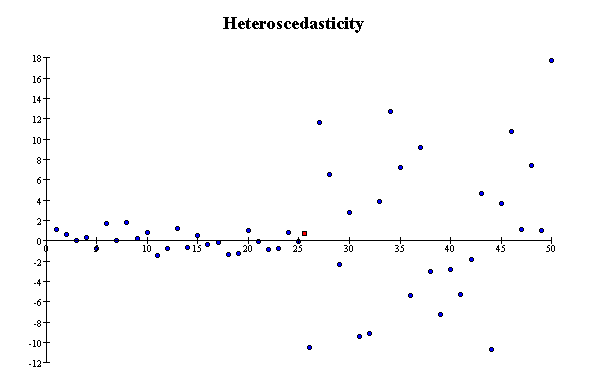
g) Scatterplots in which the scatter in Y is about the same in different vertical slices are called homoscedastic (equal scatter). Data are homoscedastic if the SD in vertical slices through the scatterplot is about the same, regardless of where you take the slice. Homoscedastic means "same scatter." In contrast, if the vertical SD varies a great deal depending on where you take the slice through the scatterplot, the data are heteroscedastic. The SD is a measure of the scatter in the list. So far, all the plots in this section have been homoscedastic. The next scatterplot shows heteroscedasticity: the scatter in vertical slices depends on where you take the slice.


h) The correlation coefficient is not a good summary of association if the data have outliers.

REGRESSION
http://www.ncbi.nlm.nih.gov/pmc/articles/PMC374386/


History: http://www.amstat.org/publications/jse/v9n3/stanton.html


INFERENTIAL
Statistics used for testing hypotheses

Correlation


regression
rank order correlation
STATISTICAL INFERENCE
ANOVA
ANCOVA

SPSS
REPORT WRITING

BASIC CONCEPTS OF SURVEY RESEARCH

BASIC CONCEPTS OF SURVEY RESEARCH
Debdulal Dutta Roy
Indian Statistical Institute, Kolkata
Venue: Andhra University
Date: 16.2. 2014


What is Survey ?

       It is an investigation about the characteristics of a given population by means of collecting data from a sample of that population and estimate their characteristics through the systematic use of statistical methodology or technique.

What is sample survey ?

       A sample survey is sampling method in which a portion only and not the whole proportion is surveyed.

 Sample

       It is a subset of a frame where elements are selected based on a randomized process with a known probability of selection.

        Representative sample: A representative sample is one that has all the important characteristics of the population from which it is drawn.

 What is sampling frame ?

It is a list of all members of a population used as a basis for sampling.

What is sampling ?

It is the research strategy of collecting data from a part of population with a view to drawing inferences about the whole.

Sample size

The number of sampling units which are to be included in the sample.

Sampling unit

It is one of the units into which an aggregate is divided for the purpose of sampling, each unit being regarded as individual or individuals.

Sampling fraction

The ratio of the sample size to the population size.

Probability sampling

       In probability sampling, each population element has a known and nonzero probability of being selected. Selection probabilities arise from the use of a randomized procedure, such as random number tables.

       It requires the existence of a sampling frame from which the sample can be drawn. Major advantage is that statistical theory can be employed to derive the properties of the sample estimators. Bias in sample selection is avoided.

Non-probability sampling

       It is any form of sampling that fails to meet the conditions for probability sampling.

Non-probability sampling techniques

         Haphazard, convenience or accidental sampling: The sampled elements are chosen for convenience or haphazardly, with the purpose of making inference about some general population. Examples include a sample of volunteers, street corner interviews, pull-out questionnaires in a magazine.

         Judgment or purposive sampling or expert choice: Sampled units are selected carefully to provide a ‘ representative sample’. This is possible when expert has a good deal of information about the population element. For example, rather than relying on random choice, the individual is selected purposefully.

         Quota sampling:  Researcher has quotas of respondents of different types to interview. For example, an interviewer may require 7 men under 55 years and 5 men 55 years or older.

Probability sampling

        Before I can explain the various probability methods we have to define some basic terms. These are:

        N = the number of cases in the sampling frame

        n = the number of cases in the sample

        NCn = the number of combinations (subsets) of n from N

        f = n/N = the sampling fraction

        That's it. With those terms defined we can begin to define the different probability sampling methods.

Simple Random Sampling

        This is the simplest form of probability sampling. To select a simple random sample you need to make a numbered list of all the units in the population from which you want to draw a sample or use an already existing one (sampling frame).

        Objective: To select n units out of N such that each NCn has an equal chance of being selected.

NCn = the number of combinations (subsets) of n from N

        Procedure: Use a table of random numbers, a computer random number generator, or a mechanical device to select the sample.

Systematic sampling

       Selection : In systematic sampling, sampled units are chosen at regular intervals from the sampling frame. For this method we randomly select a number to tell us where to start selecting individuals from the list.

       Example:  a systematic sample is to be selected from 1,200 students at a school. The sample size selected is 100. The sampling fraction is 1200/100. The sampling interval is therefore 12. The number of the first student to be included in the sample is chosen randomly, for example, by blindly picking one out of 12 pieces of paper, numbered 1 to 12. If number 6 is picked, then every twelfth student will be included in the sample, starting with student number 6, until 100 students are selected. The numbers selected would be 6, 18, 30, 42, etc.

       Advantage:  Systematic sampling is usually less time-consuming and easier to perform than simple random sampling.

       Disadvantage: However, there is a risk of bias, as the sampling interval may coincide with a systematic variation in the sampling frame. For instance, if we want to select a random sample of days on which to count clinic attendance, systematic sampling with a sampling interval of 7 days would be inappropriate, as all study days would fall on the same day of the week, which might, for example, be a market day.

Stratified sampling

          Assumption:  This technique requires classification of the total population into strata.  Here, sampling frame is divided into strata with assumption that strata will have significant effect on change in dependent variable.

          Requirement:    It requires large sample. Stratified sampling is only possible when we know what proportion of the study population belongs to each group we are interested in. An advantage of stratified sampling is that it is possible to take a relatively large sample from a small group in the study population. This makes it possible to get a sample that is big enough to enable researchers to draw valid conclusions about a relatively small group without having to collect an unnecessarily large (and hence expensive) sample of the other, larger groups. However, in doing so, unequal sampling fractions are used and it is important to correct for this when generalizing our findings to the whole study population.

          Example:  A survey is conducted on self-medication practices in a district comprising 20,000 households, of which 20% are urban and 80% rural. It is suspected that in urban areas self-medication is less common due to the vicinity of health centres. A decision is made to include 100 urban households (out of 4,000, which gives a 1 in 40 sample) and 200 rural households (out of 16,000, which gives a 1 in 80 sample). This allows for a good comparison between urban and rural self-medication practices. Because we know the sampling fraction for both strata, the rates for self-medication for all the district households can be calculated. 

Proportional Stratified Random Sampling

         Proportional or quota random sampling, involves dividing your population into homogeneous subgroups and then taking a simple random sample in each subgroup. In more formal terms:

         Objective: Divide the population into non-overlapping groups (i.e., strata) N1, N2, N3, ... Ni, such that N1 + N2 + N3 + ... + Ni = N. Then do a simple random sample of f = n/N in each strata.

         Advantage:  It represent not only the overall population, but also key subgroups of the population, especially small minority groups.

         Strata properties: Each strata must be homogenous otherwise lot of statistical precisions are required.

Cluster (Area) Random Sampling

         Use:   when we have to sample a population that's disbursed across a wide geographic region is that you will have to cover a lot of ground geographically in order to get to each of the units you sampled.

         Advantage:  It reduces travelling  time, money and energy of researcher.

         Steps:

      divide population into clusters (usually along geographic boundaries)

      randomly sample clusters

      measure all units within sampled clusters

 Multi-Stage Sampling

         It is the combination of all sampling methods.

         Example: consider the idea of sampling New York State residents for face-to-face interviews. Clearly we would want to do some type of cluster sampling as the first stage of the process. We might sample townships or census tracts throughout the state. But in cluster sampling we would then go on to measure everyone in the clusters we select. Even if we are sampling census tracts we may not be able to measure everyone who is in the census tract. So, we might set up a stratified sampling process within the clusters. In this case, we would have a two-stage sampling process with stratified samples within cluster samples. Or, consider the problem of sampling students in grade schools. We might begin with a national sample of school districts stratified by economics and educational level. Within selected districts, we might do a simple random sample of schools. Within schools, we might do a simple random sample of classes or grades. And, within classes, we might even do a simple random sample of students. In this case, we have three or four stages in the sampling process and we use both stratified and simple random sampling. By combining different sampling methods we are able to achieve a rich variety of probabilistic sampling methods that can be used in a wide range of social research contexts.

Summary

       There are two types of sampling techniques – probabilistic and non-probabilistic.


       Probabilistic sampling requires basic assumption of normal probability curve where as non probability sampling  does not need. 


Sunday, September 15, 2013

BASIC CONCEPTS OF QUALITATIVE RESEARCH

BASIC CONCEPTS OF QUALITATIVE RESEARCH
Debdulal Dutta Roy
Venue: Andhra University
Date: 16.2. 2014

1. AIM OF QUALITATIVE RESEARCH

  • To provide thick and rich descriptive accounts of the phenomena under investigation.
  • It is not concerned with counting occurrences, volumes, or the size of associations between entities like quantitative research.
  • It is generally engaged with exploring, describing and interpreting the personal and social experiences of participants.
2. Types of qualitative research

•     Phenomenology

•     Interpretative phenomenological analysis

•     Grounded theory

•     Narrative psychology

•     Conversation analysis

•     Discourse analysis

•     Focus groups


3. Phenomenology : 

•     To study how one event causes change in consciousness.

•     The goal of qualitative phenomenological research is to describe a "lived experience" of a phenomenon.

•     Researcher can use an interview to gather the participants' descriptions of their experience, or the participants' written or oral self-report, or even their aesthetic expressions (e.g. art, narratives, or poetry).

4. Interpretative phenomenological analysis

•     Aim is to explore in detail how participants are making sense of their personal and social world.

•     It is the meanings of particular experiences, events, states hold for participants.

•     It involves detailed examination of the participant’s lived experience and is concerned with an individual’s personal perception or account of an objector event, as opposed to an attempt to produce an objective statement of the object.

•     It is suitable when one is trying to find out how individuals are perceiving the particular situations they are facing, how they are making sense of their personal and social world.

5. Grounded theory

•     Aim is to build inductive theories through data analysis.

•     It consists systematic guidelines for gathering, synthesizing, analyzing and conceptualizing qualitative data to construct theory.

•     It begins with a topic or general research questions to explore and build a theoretical analysis.

6. Narrative psychology

•     Analysis of narrative text in order to explore relation between sequence of events in the text and mental states.

7. Conversation analysis

•     Conversation analysis (commonly abbreviated as CA) is an approach to the study of social interaction, embracing both verbal and non-verbal conduct, in situations of everyday life.

8. Discourse analysis

•     Developed in the 1970s, discourse analysis "concerns itself with the use of language in a running discourse, continued over a number of sentences, and involving the interaction of speaker (or writer) and auditor (or reader) in a specific situational context, and within a framework of social and cultural conventions" (M.H. Abrams and G.G. Harpham, A Glossary of Literary Terms, 2005).

9. Focus group

•     A focus group is a form of qualitative research in which a group of people are asked about their perceptions, opinions, beliefs, and attitudes towards a product, service, concept, advertisement, idea, or packaging.

•     Questions are asked in an interactive group setting where participants are free to talk with other group members.


Types of focus groups

•      Two-way focus group - one focus group watches another focus group and discusses the observed interactions and conclusion

•      Dual moderator focus group - one moderator ensures the session progresses smoothly, while another ensures that all the topics are covered

•      Dueling moderator focus group - two moderators deliberately take opposite sides on the issue under discussion

•      Respondent moderator focus group - one and only one of the respondents are asked to act as the moderator temporarily

•      Client participant focus groups - one or more client representatives participate in the discussion, either covertly or overtly

•      Mini focus groups - groups are composed of four or five members rather than 6 to 12

•      Teleconference focus groups - telephone network is used


•      Online focus groups - computers connected via the internet are used

Ref: Smith, Jonathan A. (2008). Qualitative Psychology : A practical guide to Research Methods. New Delhi: SAGE Publications. 


ETHNOGRAPHIC PERSPECTIVE

Ethnography is the study of social interactions, behaviours, and perceptions that occur within groups, teams, organisations, and communities. Its roots can be traced back to anthropological studies of small, rural (and often remote) societies that were undertaken in the early 1900s, when researchers such as Bronislaw Malinowski and Alfred Radcliffe-Brown participated in these societies over long periods and documented their social arrangements and belief systems.  Key features are:
  • A strong emphasis on exploring the nature of a particular social phenomenon, rather than setting out to test hypotheses about it
  • A tendency to work primarily with “unstructured data” —that is, data that have not been coded at the point of data collection as a closed set of analytical categories
  • Investigation of a small number of cases (perhaps even just …


PHENOMENOLOGICAL PERSPECTIVE
The goal of qualitative phenomenological research is to describe a "lived experience" of a phenomenon. As this is a qualitative analysis of narrative data, methods to analyze its data must be quite different from more traditional or quantitative methods of research.

Phenomenological research characteristically starts with concrete descriptions of lived situations, often first-person accounts, set down in everyday language and avoiding abstract intellectual generalizations. The researcher proceeds by reflectively analyzing these descriptions, perhaps idiographically first, then by offering a synthesized account, for example, identifying general themes about the essence of the phenomenon. Importantly, the phenomenological researcher aims to go beyond surface expressions or explicit meanings to read between the lines so as to access implicit dimensions and intuitions.


Wednesday, June 5, 2013

Practical of Diploma Course

GENERAL PROBLEM:  SELF-CONCEPT

SPECIFIC PROBLEM:   To determine self-concept profile similarity of two persons.

BASIC CONCEPT:  One of the important problems of Performing art therapy is to customize mental images within the sufferer so that individual can develop positive self-concept.


Self concept means, in its simplest terms, what one  thinks of own self. Everyone has some kind of mental image of themselves; their strengths and weaknesses, their looks, their status in the community. Self-concept is the set of adjectives that is used by the individual to describe one self. One's behaviour is determined by one's self-concept. Self-concept is developed by one's interaction with its surroundings. Perceiving success in the examination individual feels happy. Experiencing repeated success in the examination, individual develops academic self-confidence. 
     Semantic differential scale of Osgood is useful  instrument to assess one's degree of self-concept. Purpose of semantic differential scale is to measure various facets of the meaning of concept. Concept must be the object  or stimulus which can elicit different responses from individuals. Concept must be relevant to the problem being investigated. Concept may be of members of family, employers, teachers, public figures, ethnic or cultural groups, abstract ideas as hatred, sickness, love or product names or brand name of company. Osgood (1957) discovered 3 kinds of factors - Evaluation, Potency and Activity. Evaluation : Good-bad, Fair-unfair, Clean-dirty, Honest-dishonest.
Potency : Strong-weak, Large-small, Hard-soft, Dominant-submissive. Activity : Hot-cold, Active-passive, Tense-relaxed, Quick-slow. One can use only one factor or multiple factors according to the concept.

Extent of preference to different adjectives will elicit one's positive, negative and neutral self-concept. 
Current study aims at examining self-concept profile of two persons. It 


METHOD

Participants: Reason for selection. Their age, education, sex, marital status, caste, religion.
Inclusion and exclusion criteria.

Instruments: 
a) Information schedule
b) Semantic differential scale

Procedure of data collection:

Rapport > filling up Information schedule > Semantic differential scale
Instruction, Precautions > Introspective report

RESULTS

Profile similarity

Figures and Tables

Positive self-concept
Negative self-concept
Neutral feeling


DISCUSSION

It will focus underlying reasons for positive/negative/neutral self-concept. The Art to be used for change in self-concept.


REFERENCES
APPENDIX


Wednesday, May 29, 2013

Psychological Disorders (DIPLOMA COURSE)

LECTURE NOTES FOR THE STUDENTS OF DIPLOMA COURSE IN PERFORMING ART THERAPY

A psychological disorder, also known as a mental disorder, is a pattern of behavioral or psychological symptoms that impact multiple life areas and/or create distress for the person experiencing these symptoms. 

APPROACHES TO STUDY
There are three approaches to delineate psychiatric disorders.

Symptomatic approachThe Diagnostic and Statistical Manual of Mental Disorders (DSM) of  American Psychiatric Association and  International Statistical Classification of Diseases and Related Health Problems (ICD) of World Health Organization identified specific disorders as psychiatric disorders. List of mental disorders are available here:
http://en.wikipedia.org/wiki/List_of_mental_disorders

Cultural approach:  Psychiatric complaints vary with culture. Therefore, deviation from culture specific norm is considered as psychiatric disorders.

Statistical approach: Deviations from the normal range of specific trait are treated as psychiatric disorders. For example, low mood or depressive mood is normal but it is abnormal when it crosses normal range. Normal range is usually tested by specific psychological questionnaire or instruments. Beck depression scale is useful instrument to assess depressive illness. Community level psychiatric disorders can be studied through General Health Questionnaire.

MAJOR DISORDERS

Generalized Anxiety disorder : Generalized anxiety disorder (GAD) is a common, chronic disorder characterized by long-lasting anxiety that is not focused on any one object or situation. Those suffering from generalized anxiety disorder experience non-specific persistent fear and worry, and become overly concerned with everyday matters. It is characterized by chronic excessive worry accompanied by three or more of the following symptoms: restlessness, fatigue, concentration problems, irritability, muscle tension, and sleep disturbance.

Ref: Text book of anxiety disorder

Depression: Depression (also called dejectiondespair, and disheartenment) is a state of low mood and aversion to activity that can have (or causes) an effect on a person's thoughts, behavior, feelings, world view, and physical and subjective well-being.Depressed people may feel sad,anxious, empty, hopeless, worried, helpless, worthless, guilty, irritable, hurt, or restless. They may lose interest in activities that once were pleasurable, experience loss of appetite or overeating, have problems concentrating, remembering details, or making decisions, and may contemplate or attempt suicideInsomniaexcessive sleepingfatigue, loss of energy, or aches, pains, or digestive problems that are resistant to treatmentBeck depression scale is useful instrument to assess depressive illness

Obsessive compulsive disorder: Obsessive–compulsive disorder (OCD) is a type of anxiety disorder primarily characterized by repetitive obsessions (distressing, persistent, and intrusive thoughts or images) and compulsions (urges to perform specific acts or rituals).
   The Y-BOCS, a 10-item, clinician-administered scale, has become the most widely used rating scale for OCD. The Y-BOCS is designed to rate symptom severity, not to establish a diagnosis. The clinician should first ask the patient to complete the Y-BOCS symptoms checklist and should review the completed checklist with the patient. This can be a first step in helping patients recognize all the thoughts and behaviors that are part of their illness, and allows the clinician and patient to agree on the symptoms being rated. The checklist can also be used to select target symptoms for treatment.

Somatoform: The somatoform disorders are actually a group of disorders, all of which fit the definition of physical symptoms that mimic physical disease or injury for which there is no identifiable physical cause; as such, they are a diagnosis of exclusion. It includes
  • Conversion disorder: A somatoform disorder involving the actual loss of bodily function such as blindness, paralysis, and numbness due to excessive anxiety
  • Somatization disorder: involves multiple physical complaints which do not have a medical explanation. A patient would complain about many symptoms. [8]
  • Hypochondriasis: A somatoform disorder involving persistent and excessive worry about developing a serious illness. It is a psychological disorder in which an exaggerated belief that symptoms signify a life-threatening illness is developed when the individual is actually preoccupied with minor symptoms.
  • Body dysmorphic disorder
  • Pain disorder
  • Undifferentiated somatoform disorder – only one unexplained symptom is required for at least 6 months.
Included among these disorders are false pregnancy, psychogenic urinary retention, and mass psychogenic illness (so-called mass hysteria).

Dissociative: Dissociative disorders (DD) are conditions that involve disruptions or breakdowns of memory, awareness, identity or perception. People with dissociative disorders usedissociation, a defense mechanism, pathologically and involuntarily. Dissociative disorders are thought to primarily be caused by psychological trauma.
The five dissociative disorders listed in the American Psychiatric Association's DSM-IV are as follows:[1]
  • Depersonalization disorder: periods of detachment from self or surrounding which may be experienced as "unreal" (lacking in control of or "outside of" self) while retaining awareness that this is only a feeling and not a reality.
  • Dissociative amnesia (formerly psychogenic amnesia): the temporary loss of recall memory, specifically episodic memory, due to a traumatic or stressful event. It is considered the most common dissociative disorder amongst those documented. This disorder can occur abruptly or gradually and may last minutes to years depending on the severity of the trauma and the patient.[2]
  • Dissociative fugue (formerly psychogenic fugue): reversible amnesia for personal identity, usually involving unplanned travel or wandering, sometimes accompanied by the establishment of a new identity. This state is typically associated with stressful life circumstances and can be short or lengthy.[3]
  • Dissociative identity disorder (formerly multiple personality disorder): the alternation of two or more distinct personality states with impaired recall among personality states. In extreme cases, the host personality is unaware of the other, alternating personalities; however, the alternate personalities are aware of all the existing personalities.[3]
  • Dissociative disorder not otherwise specified: used for forms of pathological dissociation that do not fully meet the criteria of the other specified dissociative disorders.
Both dissociative amnesia and dissociative fugue usually emerge in adulthood and rarely occur after the age of 50.[citation needed] TheICD-10 classifies conversion disorder as a dissociative disorder[4] while the DSM-IV classifies it as a somatoform disorder.

Hypochondriasis: A somatoform disorder involving persistent and excessive worry about developing a serious illness. It is a psychological disorder in which an exaggerated belief that symptoms signify a life-threatening illness is developed when the individual is actually preoccupied with minor symptoms.

Mood disorder: Mood disorder is the term designating a group of diagnoses in the Diagnostic and Statistical Manual of Mental Disorders (DSM IV TR) classification system where a disturbance in the person's mood is hypothesized to be the main underlying feature.[1] The classification is known as mood (affective) disorders in ICD 10.

Schizophrenia : Schizophrenia is a chronic, severe, and disabling brain disorder that has affected people throughout history. About 1 percent of Americans have this illness.1
People with the disorder may hear voices other people don't hear. They may believe other people are reading their minds, controlling their thoughts, or plotting to harm them. This can terrify people with the illness and make them withdrawn or extremely agitated.
People with schizophrenia may not make sense when they talk. They may sit for hours without moving or talking. Sometimes people with schizophrenia seem perfectly fine until they talk about what they are really thinking.
The symptoms of schizophrenia fall into three broad categories: positive symptoms, negative symptoms, and cognitive symptoms.

Positive symptoms

Positive symptoms are psychotic behaviors not seen in healthy people. People with positive symptoms often "lose touch" with reality. These symptoms can come and go. Sometimes they are severe and at other times hardly noticeable, depending on whether the individual is receiving treatment. They include the following:
Hallucinations are things a person sees, hears, smells, or feels that no one else can see, hear, smell, or feel. "Voices" are the most common type of hallucination in schizophrenia. Many people with the disorder hear voices. The voices may talk to the person about his or her behavior, order the person to do things, or warn the person of danger. Sometimes the voices talk to each other. People with schizophrenia may hear voices for a long time before family and friends notice the problem.
Other types of hallucinations include seeing people or objects that are not there, smelling odors that no one else detects, and feeling things like invisible fingers touching their bodies when no one is near.
Delusions are false beliefs that are not part of the person's culture and do not change. The person believes delusions even after other people prove that the beliefs are not true or logical. People with schizophrenia can have delusions that seem bizarre, such as believing that neighbors can control their behavior with magnetic waves. They may also believe that people on television are directing special messages to them, or that radio stations are broadcasting their thoughts aloud to others. Sometimes they believe they are someone else, such as a famous historical figure. They may have paranoid delusions and believe that others are trying to harm them, such as by cheating, harassing, poisoning, spying on, or plotting against them or the people they care about. These beliefs are called "delusions of persecution."
Thought disorders are unusual or dysfunctional ways of thinking. One form of thought disorder is called "disorganized thinking." This is when a person has trouble organizing his or her thoughts or connecting them logically. They may talk in a garbled way that is hard to understand. Another form is called "thought blocking." This is when a person stops speaking abruptly in the middle of a thought. When asked why he or she stopped talking, the person may say that it felt as if the thought had been taken out of his or her head. Finally, a person with a thought disorder might make up meaningless words, or "neologisms."
Movement disorders may appear as agitated body movements. A person with a movement disorder may repeat certain motions over and over. In the other extreme, a person may become catatonic. Catatonia is a state in which a person does not move and does not respond to others. Catatonia is rare today, but it was more common when treatment for schizophrenia was not available.2
"Voices" are the most common type of hallucination in schizophrenia.

Negative symptoms

Negative symptoms are associated with disruptions to normal emotions and behaviors. These symptoms are harder to recognize as part of the disorder and can be mistaken for depression or other conditions. These symptoms include the following:
  • "Flat affect" (a person's face does not move or he or she talks in a dull or monotonous voice)
  • Lack of pleasure in everyday life
  • Lack of ability to begin and sustain planned activities
  • Speaking little, even when forced to interact.
People with negative symptoms need help with everyday tasks. They often neglect basic personal hygiene. This may make them seem lazy or unwilling to help themselves, but the problems are symptoms caused by the schizophrenia.

Cognitive symptoms

Cognitive symptoms are subtle. Like negative symptoms, cognitive symptoms may be difficult to recognize as part of the disorder. Often, they are detected only when other tests are performed. Cognitive symptoms include the following:
  • Poor "executive functioning" (the ability to understand information and use it to make decisions)
  • Trouble focusing or paying attention
  • Problems with "working memory" (the ability to use information immediately after learning it).
Cognitive symptoms often make it hard to lead a normal life and earn a living. They can cause great emotional distress.


CHILDHOOD DISORDERS


Mental retardation (MR) is defined by the American Association on Mental
Retardation (AAMR) as referring to substantial limitations in present functioning,
characterized by subaverage intellectual functioning existing concurrently with
related limitations in two (2) or more applicable adaptive skill areas. The adaptive
skill areas mentioned in the definition are communication, self-care, home living,
social skills, community use, selfdirection, health and safety, functional
academics, leisure and work. Mental retardation manifests before age 18.

Classifications


POSSIBLE REFERRAL CHARACTERISTICS
 A. Intellectual 
 1. Sub-average intellectual functioning; performs poorly on verbal and nonverbal intelligence tests
 2. Difficulty applying abstract processes, such as conceptualization,
 generalization, transfer
 3. Limited intellectual functioning in areas such as memory,
 imagination, creativity
 B. Academic 
 1. Subaverage learning performance in basic academic skills
 2. Experiences difficulty in activities requiring reading and listening
 comprehension, such as following complex directions, gaining
 insight into problem situations and generalizing from rules and
 principles
 3. Oral communication skills generally exceed written
 communication skills
 4. Limited in incidental learning acquired through experience
 C. Behavior 
 1. Lacks age-appropriate social skills
 2. Difficulty in comprehending social situations
Low frustration tolerance
 4. May exhibit poor self-concept
 5. Seeks approval, therefore easily influenced
 D. Communication 
 1. Below average for age in language skills
 2. Displays limited vocabulary
 3. Delayed speech and language
 4. Displays articulation disorders
 5. Limited written communication skills
 6. Slow processing of questions often resulting in delayed responses
 E. Physical 
 1. Physical development generally proceeds at a slower rate
 2. May manifest acute or chronic health pro

SLEEP DISORDERS


Sleep disorder refers to difficulty falling asleep and staying asleep with no obvious cause that causes problems in the physical, mental and social functioning of individual.
    A newborn baby until about the age of 3 months will require time to sleep almost > 20 hours/day. Children will need time to sleep for 8-14 hours depending on the age of the child. But of course this varies depending also from the child

You should begin to see that your baby has sleep disorders:
  • Woke up almost every night
  • Have hours of sleep is almost the same with you
  • Sleep continues at noon
  • Or have a bad temper because of lack of sleep at night.


  1. Primary insomnia: Chronic difficulty in falling asleep and/or maintaining sleep when no other cause is found for these symptoms.
  2. Bruxism: Involuntarily grinding or clenching of the teeth while sleeping.
  3. Delayed sleep phase syndrome (DSPS): inability to awaken and fall asleep at socially acceptable times but no problem with sleep maintenance, a disorder of circadian rhythms. 
  4. Narcolepsy: Excessive daytime sleepiness (EDS) often culminating in falling asleep spontaneously but unwillingly at inappropriate times. Also often associated with cataplexy, a sudden weakness in the motor muscles that can result in collapse to the floor.
  5. Night terror: Sleep terror disorder: abrupt awakening from sleep with behavior consistent with terror.
  6. Parasomnias: Disruptive sleep-related events involving inappropriate actions during sleep; sleep walking and night-terrors are examples.
  7. Sleep apnea, obstructive sleep apnea: Obstruction of the airway during sleep, causing lack of sufficient deep sleep, often accompanied by snoring. Other forms of sleep apnea are less common. When air is blocked from entering into the lungs, the individual unconsciously gasps for air and sleep is disturbed. Stops of breathing of at least ten seconds, 30 times within seven hours of sleep, classifies as apnea.
  8. Sleepwalking or somnambulism: Engaging in activities that are normally associated with wakefulness (such as eating or dressing), which may include walking, without the conscious knowledge of the subject.
  9. Nocturia: A frequent need to get up and go to the bathroom to urinate at night. It differs from Enuresis, or bed-wetting, in which the person does not arouse from sleep, but the bladder nevertheless empties.
Sleep disorders of children 
Sleep problems are classified into two major categories. The first is dyssomnias. In children, dyssomnias may include:
  • Sleep-onset difficulties
  • Limit-setting sleep disorder
  • Inadequate sleep hygiene
  • Insufficient sleep syndrome
  • Snoring and obstructive sleep apnea (OSA)
The second class of sleep disorders is parasomnias. Examples of common parasomnias include:
  • Sleepwalking
  • Night terrors
  • Nightmares
  • Rhythmic movement disorders such as head banging or rocking.

VISUAL IMPAIRMENT
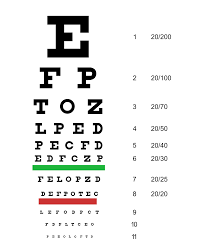
Vision is normally measured using a Snellen chart. A Snellen chart has letters of different sizes that are read, one eye at a time, from a distance of 20 ft. People with normal vision are able to read the 20 ft line at 20 ft-20/20 vision—or the 40 ft line at 40 ft, the 100 ft line at 100 ft, and so forth. If at 20 ft the smallest readable letter is larger, vision is designated as the distance from the chart over the size of the smallest letter that can be read.


Snellen chart is modified for children. This chart includes pictures - like horses of different sizes or different geometrical figures. Some are given below: 


"Visual impairment including blindness" means an impairment in vision that, even 
with correction, adversely affects a child's educational performance. The term 
includes both partial sight and blindness. Visual impairment or low vision is a severe reduction in vision that cannot be corrected with standard glasses or contact lenses and reduces a person's ability to function at certain or all tasks. The World Health Organization (WHO) defines impaired vision in five categories:

  • Low vision 1 is a best corrected visual acuity of 20/70.
  • Low vision 2 starts at 20/200.
  • Blindness 3 is below 20/400.
  • Blindness 4 is worse than 5/300
  • Blindness 5 is no light perception at all.
  • A visual field between 5° and 10° (compared with a normal visual field of about 120°) goes into category 3; less than 5° into category 4, even if the tiny spot of central vision is perfect.


This impairment refers to abnormality of 
the eyes, the optic nerve or the visual center for the brain resulting in decreased 
visual acuity.  
Students with visual impairments are identified as those with a corrected visual 
acuity of 20/70 or less in the better eye or field restriction of less that 20 degrees at 
its widest point or identified as cortically visually impaired and functioning at the 
definition of legal blindness.