Saturday, September 29, 2012

Person-centered therapy or Client - centered therapy


LECTURE NOTES OF PERSON-CENTERED 

THERAPY

D. Dutta Roy

Venue: Performing Arts Therapy Center, Rabindra Bharati University, Kolkata

INTRODUCTION
Person-centered therapy (PCT) is also known as person-centered psychotherapy, person-centered counseling, client-centered therapy and Rogerian psychotherapy. PCT is a form of talk-psychotherapy developed by psychologist Carl Rogers in the 1940s and 1950s. 


AIMS
The goal of PCT is to provide patients with an opportunity to develop a sense of self wherein they can realize how their attitudes, feelings and behavior are being negatively affected and make an effort to find their true positive potential. In this technique, therapists create a comfortable, non-judgmental environment by demonstrating congruence (genuineness), empathy, and unconditional positive regard toward their patients while using a non-directive approach. This aids patients in finding their own solutions to their problems. Rogers believed that the most important factor in successful therapy is the therapist's attitude. There are three interrelated attitudes on the part of the therapist:

  1. Congruence -the willingness to relate to clients without hiding behind a professional facade.
  2. Unconditional Positive Regard - therapist accepting client for who he or she is without disapproving feelings, actions or characteristics. It shows the willingness to listen without interrupting, judging or giving advice.
  3. Empathy -Understand and appreciate the client's feeling throughout the therapy session.
Stages of Therapeutic Change:
The process of constructive personality change can be placed on a continuum from most ‘defensive’ to most ‘integrated’. Rogers (1961) arbitrarily divided this continuum into seven stages.
Stage 1 is characterized by an unwillingness to communicate anything about oneself. People at this stage ordinarily do not seek help, but if for some reason they come to therapy, they are extremely rigid and resistant to change. They do not recognize any problems and refuse to own any personal feelings or emotions.

In Stage 2, clients become slightly less rigid. They discuss external events and other people, but they still disown or fail to recognize their own feelings. However, they may talk about personal feelings as if such feelings were objective phenomena.
As clients enter into Stage 3, they more freely talk about self, although still as an object. “I’m doing the best I can at work, but my boss still doesn’t like me.” Clients talk about feelings and emotions in the past or future tense and avoid present feelings. They refuse to accept their emotions, keep personal feelings at a distance from the here-and-now situation, only vaguely perceive that they can make personal choices, and deny individual responsibility for most of their decisions.
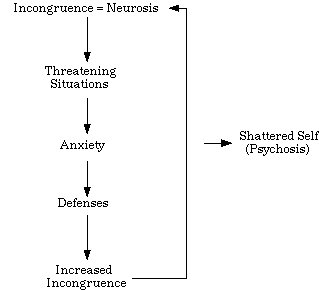
Clients in Stage 4 begin to talk of deep feelings but not ones presently felt. “I was really burned up when my teacher accused me of cheating.” When clients do express present feelings, they are usually surprised by this expression. They deny or distort experiences, although they may have some dim recognition that they are capable of feeling emotions in the present. They begin to question some values that have been introjected from others, and they start to see the incongruence between their perceived self and their organismic experience. They accept more freedom and responsibility than they did in Stage 3 and begin to tentatively allow themselves to become involved in a relationship with the therapist.
By the time clients reach Stage 5, they have begun to undergo significant change and growth. They can express feelings in the present, although they have not yet accurately symbolized those feelings. They are beginning to rely on an internal locus of evaluation for their feelings and to make fresh and new discoveries about themselves. They also experience a greater differentiation of feelings and develop more appreciation for nuances among them. In addition, they begin to make their own decisions and to accept responsibility for their choices.
People at Stage 6 experience dramatic growth and an irreversible movement toward becoming fully functioning or self-actualizing. They freely allow into awareness those experiences that they had previously denied or distorted. They become more congruent and are able to match their present experiences with awareness and with open expression. They no longer evaluate their own behavior from an external viewpoint but rely on their organismic self as the criterion for evaluating experiences. They begin to develop unconditional self-regard, which means that they have a feeling of genuine caring and affection for the person they are becoming. An interesting concomitant to this stage is a physiological loosening. These people experience their whole organismic self, as their muscles relax, tears flow, circulation improves, and physical symptoms disappear. In many ways, Stage 6 signals an end to therapy. Indeed, if therapy were to be terminated at this point, clients would still progress to the next level.
Stage 7 can occur outside the therapeutic encounter, because growth at Stage 6 seems to be irreversible. Clients who reach Stage 7 become fully functioning “persons of tomorrow” (a concept more fully explained in the section titled The Person of Tomorrow). They are able to generalize their in-therapy experiences to their world beyond therapy. They possess the confidence to be themselves at all times, to own and to feel deeply the totality of their experiences, and to live those experiences in the present. Their organismic self, now unified with the self-concept, becomes the locus for evaluating their experiences. People at Stage 7 receive pleasure in knowing that these evaluations are fluid and that change and growth will continue. In addition, they become congruent, possess unconditional positive self-regard, and are able to be loving and empathic toward others.

OUTCOME

The Person of Tomorrow
           If the three necessary and sufficient therapeutic conditions of congruence, unconditional positive regard, and empathy are optimal, then what kind of person would emerge? Rogers (1961, 1962, and 1980) listed several possible characteristics.
First, psychologically healthy people would be more adaptable. Thus, persons of tomorrow would not merely adjust to a static environment but would realize that conformity and adjustment to a fixed condition have little long-term survival value.
Second, persons of tomorrow would be open to their experiences, accurately symbolizing them in awareness rather than denying or distorting them. This simple statement is pregnant with meaning. For people who are open to experience, all stimuli, whether stemming from within the organism or from the external environment, are freely received by the self. Persons of tomorrow would listen to themselves and hear their joy, anger, discouragement, fear, and tenderness.
A related characteristic of persons of tomorrow would be a trust in their organismic selves. These fully functioning people would not depend on others for guidance because they would realize that their own experiences are the best criteria for making choices; they would do what feels right for them because they would trust their own inner feelings more than the pontifications of parents or the rigid rules of society. However, they would also perceive clearly the rights and feelings of other people, which they would take into consideration when making decisions.
A third characteristic of persons of tomorrow would be a tendency to live fully in the moment. Because these people would be open to their experiences, they would experience a constant state of fluidity and change. What they experience in each moment would be new and unique, something never before experienced by their evolving self. They would see each experience with a new freshness and appreciate it fully in the present moment.
Fourth, persons of tomorrow would remain confident of their own ability to experience harmonious relations with others. They would feel no need to be liked or loved by everyone, because they would know that they are unconditionally prized and accepted by someone. They would seek intimacy with another person who is probably equally healthy, and such a relationship itself would contribute to the continual growth of each partner. Persons of tomorrow would be authentic in their relations with others. They would be what they appear to be, without deceit or fraud, without defenses and facades, without hypocrisy and sham. They would care about others, but in a nonjudgmental manner. They would seek meaning beyond themselves and would yearn for the spiritual life and inner peace.
Fifth, persons of tomorrow would be more integrated, more whole, with no artificial boundary between conscious processes and unconscious ones. Because they would be able to accurately symbolize all their experiences in awareness, they would see clearly the difference between what is and what should be; because they would use their organismic feelings as criteria for evaluating their experiences, they would bridge the gap between their real self and their ideal self; because they would have no need to defend their self-importance, they would present no facades to other people; and because they would have confidence in who they are, they could openly express whatever feelings they are experiencing.
Sixth, persons of tomorrow would have a basic trust of human nature. They would not harm others merely for personal gain; they would care about others and be ready to help when needed; they would experience anger but could be trusted not to strike out unreasonably against others; they would feel aggression but would channel it in appropriate directions.
Finally, because persons of tomorrow are open to all their experiences, they would enjoy a greater richness in life than do other people. They would neither distort internal stimuli nor buffer their emotions. Consequently, they would feel more deeply than others. They would live in the present and thus participate more richly in the ongoing moment.

Source:  life sketch 

Cognitive Behavior therapy


Cognitive-Behaviour therapy(CBT)


CBT is the outcome of basic behavioural (Thorndike, Pavlo) and cognitive researches (Aaron Beck and Albert Ellis).


It assumes that each person has a different thought process associated with every circumstance in life. For instance, while one person may see a “trigger” such as a fire truck and react with optimism saying “I hope there is no emergency,” another person may immediately panic and take on the mindset of “oh no someone has definitely died or lost their home to a fire.” 


CBT  allows patients to self develop (with therapeutic assistance) new thoughts and beliefs that will help them to be productive and overcome issues they may be facing. These self help tools can be utilized in various situations in life where our grid iron belief system or ‘opinions’ are so deeply ingrained that they cause automated and negative responses.

CBT is not distinct therapeutic technique. It includes several approaches - Rational emotive behavior therapy, Rational behavior therapy, Rational living therapy, Cognitive therapy and Dialectic behavior  However, mot CBT have the following characteristics:

Characteristics:
1. Our thoughts cause our feelings and behavior, not external things. So, we can change the way we think to feel/act better even if the situation does not change.
2. CBT is briefer (max 16 sessions) and time limited.
3. CBT therapists believe that the clients change because they learn how to think differently and they act on that learning. It focuses on teaching rational self-counselling skills.
4. It is a collaborative effort between therapist and client. Therapist will listen, teach and encourage, while the client's roles is to express concerns, learn and implement that learning.
5. CBT does not tell people how they should feel.
6.Here therapist encourages clients to ask questions of themselves, like, " How do I really know that these people are laughing at me? ". " Could they be laughing about something else? "
7. Cognitive-behavioral therapists have a specific agenda for each session. Specific techniques / concepts are taught during each session.  CBT focuses on the client's goals. Therefore, CBT therapists do not tell their clients what to do -- rather, they teach their clients how to do.
8. CBT assumes  that most emotional and behavioral reactions are learned.  Therefore, the goal of therapy is to help clients unlearn their unwanted reactions and to learn a new way of reacting.  

Applications:

CBT is useful for  anxiety, depression, panic, phobias (including agoraphobia and social phobia), stress, bulimia, obsessive compulsive disorder, post-traumatic stress disorder, bipolar disorder and psychosis. CBT may also help if you have difficulties with anger, a low opinion of yourself or physical health problems, like pain or fatigue. CBT analyzes different cognitive distortions


Cognitive distortions:
The term “cognitive distortion” refers to errors in thinking or patterns of thought that are biased in some way.  They may include:  (A) interpretations that are not very accurate and which selectively filter the available evidence, (B) evaluations that are harsh and unfair, and/or (C) expectations for one self and for others that are rigid and unreasonable.  The more a person’s thinking is characterized by these distortions, the more they are likely to experience disturbing emotions and to engage in maladaptive behavior.  A number of common patterns2 of cognitive distortions have been identified, including: 
1.  All-or-nothing thinking:  Looking at things in absolute, black-and-white categories, instead of on a continuum.  For example, if something is less than perfect, one sees it as a total failure.
2.  Overgeneralization:  Viewing a negative event as a part of a never-ending pattern of negativity while ignoring evidence to the contrary.  You can often tell if you’re overgeneralizing if you use words such as never, always, all, every, none, no one, nobody, or everyone.
3.  Mental filter:  Focusing on a single negative detail and dwelling it on it exclusively until one’s vision of reality becomes darkened. 
4.  Magnification or minimization (e.g., magnifying the negative and minimizing the positive):  Exaggerating the importance of one’s problems and shortcomings.  A form of this is called “catastrophizing” in which one tells oneself that an undesirable situation is unbearable, when it is really just uncomfortable or inconvenient.
5.  Discounting the positive:  Telling one self that one’s positive experiences, deeds, or personal qualities don’t count in order to maintain a negative belief about oneself.  Or doing this to someone else.
6.  Mind reading:  Concluding what someone is thinking without any evidence, not considering other possibilities, and making no effort to check it out.
7.  Fortune telling:  Anticipating that things will turn out badly, and feeling convinced that the prediction is an already established fact.  It often involves:  (A) overestimating the probability of danger, (B) exaggerating the severity of the consequences should the feared event occur, and (C) underestimating one’s ability to cope should the event occur.  B and C are also examples of catastrophizing.
8.  Emotional reasoning:  Assuming that one’s negative emotions necessarily reflect the way things really are (e.g., “Because I feel it, it must be true.” “I feel stupid, therefore I am stupid”). 
9.  Rigid rules (perfectionism).  Having a precise, fixed idea of how one self or others should behave, and overestimating how bad it is when these expectations are not met.  Often phrased as "should" or “must” statements.  
10.  Unfair judgments:  Holding oneself personally responsible for events that aren't (or aren’t entirely) under one’s control, or blaming other people and overlooking ways in which one might have also contributed to the problem.
11.  Name-calling:  Putting an extremely negative and emotionally-loaded label on oneself or others.  It is an extreme form of magnification and minimization, and also represents a gross overgeneralization. 
In addition to the above list which is largely influenced by Aaron Beck’s version of cognitive therapy, Albert Ellis produced a similar list that highlights what he called irrational beliefs (which consist of faulty assumptions and unreasonable rules about life).

Phases 
According to Gatchel et al. (2008), CBT has six phases:
1. Assessment
2. Reconceptualization
3. Skills acquisition
4. Skills consolidation and application training
5. Generalization and maintenance
6. Post-treatment assessment follow-up


Sources:
1. CBT

Friday, September 21, 2012

Transactional Analysis

Lecture notes on Transactional Analysis

D. Dutta Roy

Venue: Performing Arts Therapy Centre, Rabindra Bharati University

Eric Berne
In the 1950's Eric Berne began to develop his theories of Transactional Analysis. He said that verbal communication, particularly face to face, is at the centre of human social relationships and psychoanalysis. His starting-point was that when two people encounter each other, one of them will speak to the other. This he called the Transaction Stimulus. The reaction from the other person he called the Transaction Response. The person sending the Stimulus is called the Agent. The person who responds is called the Respondent. Transactional Analysis became the method of examining the transaction wherein: 'I do something to you, and you do something back'. TA concepts include three things:


EGO STATES


Berne also said that each person is made up of three alter ego states: Parent, Adult and Child. These terms have different definitions than in normal language.

Parent: This is our ingrained voice of authority, absorbed conditioning, learning and attitudes from when we were young. We were conditioned by our real parents, teachers, older people, next door neighbours, aunts and uncles, Father Christmas and Jack Frost. Our Parent is made up of a huge number of hidden and overt recorded playbacks. Typically embodied by phrases and attitudes starting with 'how to', 'under no circumstances', 'always' and 'never forget', 'don't lie, cheat, steal', etc, etc. Our parent is formed by external events and influences upon us as we grow through early childhood.
    Parent ego state is of two types: Nurturing and critical. Nurturing state of parent ego state is soft, loving, compassionate and permission giving. Critical state includes prejudiced thoughts.

Child:   Our internal reaction and feelings to external events form the 'Child'. This is the seeing, hearing, feeling, and emotional body of data within each of us. When anger or despair dominates reason, the Child is in control. Like our Parent we can change it, but it is no easier. Child ego state is of two types:
natural (free child) and adapted (rebellious) child.

Adult: It is the data processing center. It processes the data accurately.


TRANSACTIONS: There are two types of transactions - complimentary and crossed. Complimentary transactions In straight transactions, communication can continue indefinitely.


Complimentary transactions

But in crossed transaction, communication easily breaks down.

Crossed transaction


STROKES: When one recognizes other by talk, look, nod,smile. It is stroke. Stroke may be positive or negative.


LIFE SCRIPTS:

A life script is an unconscious life plan based on decisions made in early childhood about ourselves, others, and our lives.


Sources: Transactional analysis theory: the basics

Monday, August 6, 2012

Lecture note on attitude, beliefs and values

Lecture note on attitude, beliefs and values 

Debdulal Dutta Roy
Indian Statistical Institute, Kolkata

Attitude:       Attitudes may be viewed as learned cognitive, affective, and behavioral predispositions to respond positively or negatively to certain objects, situations, institutions, concepts and persons. 

Opinion:     is the overt, conscious, verbal demonstration of attitude. It is less central, more specific, more changeable, and more factually based.

Value:   is a shared, enduring belief about ideal modes of behaviour or end states of existence. 

STUDY OF VALUES


Sunday, August 5, 2012

Lecture notes on Intelligence Testing


D. Dutta Roy
Indian Statistical Institute, Kolkata, India

In performing art therapy, knowledge about intelligence is important to get insight about screening, prognosis and selection of different therapeautic modules. The well accepted definition of intelligence is given below:


Spearman (1904) : a general ability that involves mainly the education of relations and correlates.


Binet and Simon (1905): the ability to judge well, to understand well, to reason well.


Thurstone (1921): the capacity to inhibit instinctive adjustments, flexibly imagine different responses, and realize modified instinctive adjustments into overt behaviour.


Wechsler (1939): the aggregate or global capacity of the individual to act purposefully, to think rationally, and to deal effectively with the environment.


Sternberg (1986): the mental capacity to automatize information processing and to emit contextually appropriate behaviour in response to novelty: intelligence also includes metacomponents, performance components, and knowledge-acquisition components.


Gardner (1986): the ability or skill to solve problems or to fashion products that are valued within one or more cultural settings.

Theories of intelligence

Two factor theories: Charles Spearman (1927) proposed that intelligence consisted of two kinds of factors: a single general factor and numerous specific factors and so on. He believed that individual differences in g were most directly reflected in the ability to use three principles of cognition: apprehension of experience, education of relations, and education of correlations. A simple example is Hammer : nail :: screwdriver : ?
To solve the problem, one must have prior experience of hammer, nail and screwdriver (apprehension of experience), the ability to establish relations between the objects and finally the correlation among three things. These three will find out right answer, i.e., screw. Primary abilities: Thurstone (1931) proposed several primary abilities. They can be grouped into seven abilities as verbal comprehension, word fluency, number, space, associative memory, perceptual speed and inductive reasoning.
  1. verbal comprehension: it involves reading comprehension and verbal analogies;
  2. word fluency: it includes anagram or quickly naming words in a given category;
  3. number: it includes speed and accuracy of simple arithmetic computation;
  4. space: it is the ability to visualize how a three-dimensional object would appear if it was rotated or partially disassembled;
  5. associative memory: it includes learning to associate pairs of unrelated items;
  6. perceptual speed : it involves checking for similarities and differences in visual details;
  7. inductive reasoning: it involves finding a rule, as in a number series completion test.
Adaptation theory: Jean Piaget (1896 - 1980) was employed at the Binet Institute in the 1920s, where his job was to develop French versions of questions on English intelligence tests. He became intrigued with the reasons children gave for their wrong answers on the questions that required logical thinking. He believed that these incorrect answers revealed important differences between the thinking of adults and children. Piaget was the first psychologist to make a systematic study of cognitive development. His contributions include a theory of cognitive child development, detailed observational studies of cognition in children, and a series of simple but ingenious tests to reveal different cognitive abilities. Before Piaget’s work, the common assumption in psychology was that children are merely less competent thinkers than adults. He through his cognitive development theory postulated following points:
  1. children's thought is qualitatively different from adult's thought: Conservation concept of child differs from adult. Conservation refers to the awareness that physical quantities do not change in amount when they are superficially altered in appearance.
  2. schemas are the primary basis for gaining new knowledge about the world;there are four stages of cognitive development. These are 
  •  Sensorimotor 0 - 2 yrs. 
  • Preoperational 2 - 7 yrs.
  • Concrete Operational: 7 – 11 yrs.
  • Formal Operational: 11yrs +
Schema: To Piaget, schema is an organized pattern of behaviour or a well-defined mental structure that leads to knowing how to do something. Young infants possess schemas that are mainly sensorimotor in nature. such as the grasp-and-pull schema that allows a baby to retrieve a desired object and bring it up to the mouth.As we grow older, we add mental structures to our collection of sensorimotor schemas. For example, teeenagers usually possess the alphabeitizing schema that permits them to find a word in a dictionary. Schemas evolve toward greater levels of complexity by the process of equilibration.

Equilibration: It has three concepts as assimilation, accommodation and equilibrium
  • Assimilation: It is the application of a schema to an object, person or event. Infant uses grasp-and-pull schema to retrieve a baby rattle and bring it to the mouth. 
  • Accommodation: The above schema is modified and become the grasp-and-pull-and-turn schema. 
  • Equilibrium: it is the success of schema application. Success leads to state of equilibrium.
Sternberg (1996) is proposing that certain mental mechanisms are required for intelligent behaviour, he also emphasized that intelligence involves adaptation to the real-world environment. His theory emphasizes what he calls successful intelligence or " the ability to adapt to, shape, and select environments to accomplish one's goals and those of one's society and culture". His theory is called triarchic (ruled by three) because it deals with three aspects of intelligence; componential intelligence, experiential intelligence and contextual intelligence. 


Componential intelligence:

  • metacomponents or executive processes: planning 
  • perfomance components : short term memory and syllogistic reasoning
  • knowledge acquisition components: ability to acquire vocabulary words.
Experiential intelligence:   
  • ability to deal with novelty
  • ability to automatize information processing
Contextual intelligence:
  • adaptation to real world environment
  • selection of suitable environment
ASSESSMENT OF INFANT ABILITY
  1. Gesell developmental schedule:  Gesell Developmental Schedules are a gauge of the status of a child's motor and language development and personal-social and adaptive behaviors.
  1. Neonatal Behavioral assessment scale
  2. Ordinals scales of psychological development
  3. Bayley scales of infant development-II
ASSESSMENT OF PRESCHOOL INTELLIGENCE
  1. Wechsler Preschool and Primary scale of Intelligence (WPPSI-R)
  2. Stanford-Binet : Fourth edition
  3. Kaufman assessment battery for children
  4. McCarthy scales of Children's abilities


Monday, June 11, 2012

Personality profile similarity

1. Trait And Type Theories Of Personality2. Uses Of Personality Test In Clinical, Education And Industrial Settings.3. Orientation About Scales Of Measurement To Assess Personality4. Characteristics Of Good Instrument Measuring Personality5. Profile Matching Statistical Models


Personality is the strong determinant of individual's behaviour. Therefore, understanding different principles of personality profile similarity is important for various activities like counselling, therapy, selection, training, placement and even analyzing one's economic behaviour.

Before going to understand personality profile similarity, it is important to understand the trait and type theories of personality.

Trait theory
 
 According to the Diagnostic and Statistical Manual of the American Psychiatric Association, Personality traits are enduring patterns of perceiving, relating to, and thinking about the environment and oneself that are exhibited in a wide range of social and personal contexts. This definition assumes that (a) traits are relatively stable over time, (b) traits differ among individuals (e.g. some people are outgoing while others are shy), and (c) traits influence behavior.

Trait theorists do not assume that some people have a trait and others do not rather, they propose that all people possess certain traits, but that the degree to which a given trait applies to a specific person varies and can be quantified. For example one can find differences in outgoing behavior among a set of individuals.

Gordon Allport assumed three categories of personality traits - cardinal, central and secondary. Cardinal trait is a single that directs most of a person's activities. For example, a totally selfless woman might direct all her energies toward humanitarian activities.
Gordon Allport
  But most people do not develop all encompassing cardinal traits. Instead, they possess a handful of central traits that make up the core of the of their personality for example honesty and sociability. Finally, secondary traits are characteristics that affect behavior in fewer situations and are less influential than central or cardinal traits. For example, a preference for ice cream or disliking modern art can be considered as secondary trait.

Allport suggested different ways to assess individual's personality like open ended interviews, attitude to life, their short and long term goals, beliefs, studying letters and diaries as well as other written material belonging to person. His approach is favored by the case study method and ideographic approach to assess personality.
  Allport is often criticized by Nomothethic theories. Nomothetic theorists assume that Allport's approach is oversimplified. If two people are aggressive, can we assume that two people are equally aggressive ? Possibly not. Aggression may be very different and be exhibited in different ways, at different times and for different reasons.

Cattell
Cattell and Eysenck attempted to identify primary traits of personality through a statistical technique known as factor analysis. Factor analysis is a method of summarizing the relationships among large number of variables into fewer, more general patterns. But they noted different traits possibly following different types of factor analysis. Cattell used oblique and Eysenck used varimax rotation.
Cattell found that 16 source traits represented the dimensions of personality. Using these source traits, he developed sixteen personality factor questionnaire or 16PF, a measure that provides scoresfor each of the source traits.


Eysenck

    Eysenck found that personality could be described in terms of just two major dimensions: introversion-extraversion and neurotic-stability. At one extreme of the introversion-extraversion dimension are the introverts and at the other extreme are extroverts. Independently of this dimension, people can be rated as neurotic versus stable. Eysenck constructed one questionnaire known as Eysenck Personality Questionnaire.


The questionnaire includes two options (yes/No) that can not do justice to predict the  complex and changeable nature of human personality. So, findings of the questionnaire must be interpreted cautiously. Eysenck's two personality traits - extraversion and neuroticism were accepted by the researchers of Big-five personality. Big-five researchers proposed five personality traits - openness to experience, neuroticism, conscientiousness, extraversion and agreeableness.


Description of NEO

NEO inventories are concise measure of five major dimensions or domains of personality. It comprises a series of closely related instruments developed over a period of 30 years from the original inventory, a measure of 18 traits grouped into the domains of Neuroticism (N), Extraversion (E), and openness to experience (O). Since 1985, the inventories included measures of two other basic dimensions of personality, Agreeableness (A) and Conscientiousness (C). Each domain includes 6 more specific traits. The inventory measures differences in personality traits. It is not a test of intelligence or ability and is not intended to diagnose psychiatric disorders. It gives some idea about what makes one unique in ways of thinking, feeling and interacting with others.

N-domain
Traits in the N-domain reflect different ways of reacting emotionally to distressing circumstances. Low scorers are resilent, rarely experiencing negative emotions. High scorers are anxious, generally apprehensive and prone to worry.

E-domain
The E-domain measures traits related to energy and enthusiasm, especially when dealing with people. Low scorers are outgoing and extraverts.

O-domain
Low scorers in this domain are down-to-earth and conventional; they prefer the familiar and the tried and true. High scorers are imaginative and openminded.

A-domain
This domain is concerned with styles of interpersonal interaction. Low scorers are hard-headed and competitive; high scorers are compassionate and co-operative.

C-domain
Traits in the domain describe differences in motivation and persistence. Low scorers are easygoing and not inclined to make plans or schedules. High scorers are conscientious and well organized. They are rational, prudent, practical, resourceful and well prepared.

Assessment(adult)

1. Score 60-items NEO (adult version)
2. Assign the data in  MS-excel sheet frm col. B
3. Reverse data according to manual
4. Compute total score in the following ways:
Neuroticism: =(B2+G2+L2+Q2+V2+AA2+AF2+AK2+AP2+AU2+AZ2+BE2)
Neuroticism
=C2+H2+M2+R2+W2+AB2+AG2+AL2+AQ2+AV2+BA2+BF2
Openness
=D2+I2+N2+S2+X2+AC2+AH2+AM2+AR2+AW2+BB2+BG2
Aggreableness
=E2+J2+O2+T2+Y2+AD2+AI2+AN2+AS2+AX2+BC2+BH2
Conscientious
=F2+K2+P2+U2+Z2+AE2+AJ2+AO2+AT2+AY2+BD2+BI2
5. Transform raw score into T-score according to the manusal
6. Estimate percentile position of each variable and interpret data according to the manual.


Comparison between Western and Indian Study on NEO

McCrae and Costa (N=500)
Current study (N=105)*
Variable
Mean
S.D.
Mean
S.D.
Neuroticism
23.3
7.3
36.49
5.09
Extraversion
29.7
6.3
39.55
5.93
Openmindedness
29.1
6.8
41.27
4.68
Aggreeableness
28.2
5.8
38.48
4.63
Conscientious
27.9
6.8
45.23
5.86

* Conducted on adult by D. Dutta Roy


Type theory:
It includes categorizing people in terms of distinct features. For example, he is extraverted or introverted. It follows principles of all or none. Either he is extraverted or none. It does not consider extent of variation. It follows oversimplified principle. It is often called as conglomeration of set of personality traits. For example, If Sundarajan is extraverted, he is outgoing, talkative, social etc.

USES OF PERSONALITY TESTS

Since personality traits are found as determinants of behaviour, researchers tend to relate personality traits in different settings like clinical, education and industrial settings.

Clinical settings include psychiatric hospitals,  community mental health centres. Principal purpose of the psychological assessment is to help diagnose and classify individuals' emotional or behavioural problems. This type of information is very useful in determining the efficient treatment strategies.
 
Counselling settings include educational institutions, rehabilitation centers and a variety of industrial settings. In counselling settings, counselling psychologists work to help individuals cope with and adjust more effectively to problems in their daily life (e.g., loneliness, job dissatisfaction etc.).

Legal settings include courtrooms, prisons and law enforcement agencies. Information from personality tests is used as evidence in judicial proceedings to help determine whether a person is same and can be held responsible for criminal actions or whether an inmate is ready for probation.Personality tests also are used for selection of jury members.

Guidance settings are the high schools, colleges and vocational guidance centers. Personality assessment helps individuals to make educational and vocational decisions.


PROFILE SIMILARITY

Personality trait theory suggests that each individual possesses trait to a various extent. Possession of the different extent of trait helps in understanding profile similarity. One's different parameters of personality trait can be assumed as one's profile of personality traits. One's personality may be conveged with other individual or the group he belongs to due to role learning. Similarly, one can be diverged from other group. This convergence and divergence is important for career counselling, therapy, selection, training and placement. Norm represents group profile so one's close and distance association from the norm gives idea about classification of individual. This approach is called normative approach.


Normative model
a) Individual VS individual
b) Individual VS group
c) Group VS group

Besides norm, one can use facet theory in assessing personality profile similarity.  The widely used facet theory states that every analytical object can be decomposed into certain number of distinct dimensions or facets. Combination of different facets is called structure. The structure is the realization of possible linear combinations of facets.


Structural approach
a) Principal component analysis or factor analysis
b) Correspondence analysis
c) Cluster analysis

When the measurement scales are metric, it is better to use principal component analysis. When it is categorical in nature, correspondence analysis is useful. Cluster analysis is also useful to determine the outlier.

Predictive approach
Predictive model suggests that success in occupation depends on set of criteria. So one's association with the criterion is most important.
a) Discriminant function analysis


Correlation approach
a) Spearman rank order correlation
b)

Geometric distance approach
a) Cluster analysis

Multivariate

ANOVA approach
Factor analytic approach


Predictive model
a) Relation between individual/group profile and criterion variable
b) Discriminant function analysis


Tuesday, June 5, 2012

Imitative learning

Imitative learning theory is based on Social cognitive learning approach of Bandura. It assumes that one can learn through imitation. Imitation learning has following characteristics:

1. There will be one model upon which imitation will take place. For example, child imitates his parents' eating or talking  style.


2. Observing other's behaviour is important so that reciprocal determination can take place.


 3. The imitative behaviour must not be resulted in negative consequence.

4.  Repeated observation is required so that one can act without absence of model in future.

5. It includes learned expectation that one is capable of carrying out a behaviour or producing a desired outcome.