Thursday, March 26, 2015

Psychographic analysis for Amrita University

17.2.2012

In Marketing research one of the major problem is to classify the customers as marketing has to determine which segments offer the best opportunities. The process of dividing a market into distinct groups of buyers who have different needs, characteristics or behaviors, who might require separate products or marketing program, is called market segmentation.
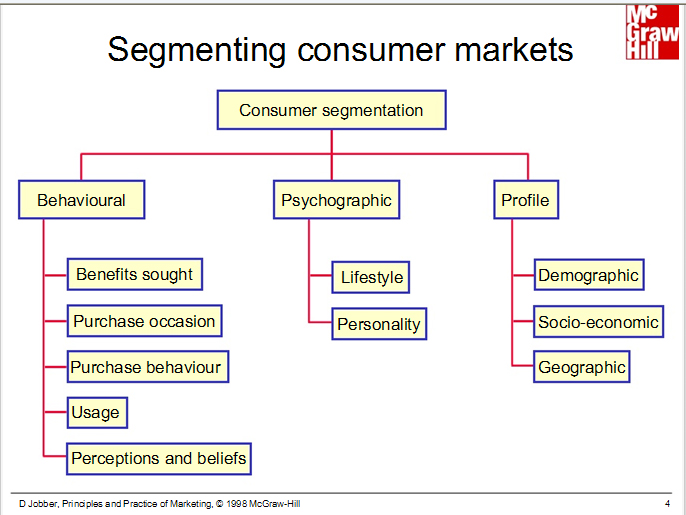
For classification, generally, demographic data are used. It is noted that some psychological factors play critical roles in changing consumer's attitude. These are intangible variables such as need profile, personality, interests, values and life styles of potential customer. For example purchasing speedy motor car depends not only on socioeconomic condition but also one's risk taking personality trait.
The idea is that marketers can sell the product to enhance the life style of the consumers. For example, by defining bathing style of customers using bar soap, marketers push liquid soap to enhance life style of the consumers. In life style analysis, marketing researcher should study all the activities of consumers - working, shopping, holiday and social life. In analysis of behaviour, followings will be taken into account as End use, Benefits sought, loyalty, usage rate etc.Alexandre Psychographic profile data can be used for brand development
Psychographic data provide market intelligence to the company. Based on psychographic segmentation, company can modify it's width or depth of business. It is the process of exploring business opportunities or to identify specific opportunities for cross sell or up sell.

LIFE STYLE

Cell phone research:

How often
  1. do you send text message?
  2. do you talk on cell phone ?
  3. do you use social networking site ?
  4. do you meet person outside your school work ?
  5. do you often talk on landline phone ?
  6. do you use e-mail?

25.3.15

Collection from study.com


Psychographic data are important for market segmentation so that market potential across different segmented markets can be understood. Most marketing departments use multiple segmentation strategies.

Multiple Segmentation Strategies
Geography
Demographics
Psychographics
Benefits sought
Usage rate

Geographic Segmentation
One of the first variables that the team could use in their segmentation strategy is geographic. This would allow the team to break the market into sections by climate, density, market size, world or states. Many companies use climate if their products or services rely on the weather, such as snow shovels, melting pavement salt, wave runners and boats. Our Town USA is more interested in targeting geographic locations that are located near the park in a 100-mile radius. They believe some customers will fly in from out of state, so in addition, they will target large-density areas nearby.

Demographic Segmentation
Demographic segmentation is extremely important to all marketing departments since the data is easily available and does drastically affect buying patterns. Age, income, gender, ethnic background and family life cycle are all important factors of demographic segmentation. The park is going to use an age range of 2-60 years of age so they can include kids, teens, parents and even grandparents. The income level would have to be middle to upper class - $50,000 annual income or above - since park tickets are very expensive. The amusement park is not a gender-specific product, and ethnicity will also not affect the overall plan.

The marketing team is very interested in the family life cycle sub-segments. Family life cycle segmentation is a series of stages determined by a combination of age, marital status and the number of children in a household. Obviously, the park is very interested in the family life cycle of young single, young married with kids, middle-aged married with kids, young divorced with children and middle-aged divorced with kids. They plan on advertising via social media and local cable ads where parents and kids congregate.


RESEARCH DESIGN
In this analysis, the dependent variables are
how frequently customers purchase a given item, how much they spend on the item per year, and what factors cause them to purchase the item.


Some useful links are:
http://www.ehow.com/info_8244606_psychographic-data-marketing.html
Lifestyle psychographic:http://www.warc.com/fulltext/esomar/80217.htm
Big-5: http://digitalmarketingmagazine.co.uk/digital-marketing-features/psychographic-profiling-identifying-new-levels-of-customer-understanding/787
Substance abuse : http://www.ncbi.nlm.nih.gov/pubmed/24729744


Thursday, March 12, 2015

SPSS training for Doctoral students of Psychology, University of Calcutta

GENERAL OUTLINE

SPSS is the statistical package for scientific researches in social sciences like psychology, sociology, economics and in engineering sciences. In social sciences, there are large number of variables and cases. Specific distribution of variable or case or association among set of variables or cases can be examined by SPSS.

    SPSS provides both menu and syntax driven approaches in analysis of data. In menu driven approach, researcher uses the icons of the SPSS tool bars. In syntax approach, researcher writes the programme in the syntax window and runs it for the output. Syntax approach is always better than menu driven,as researcher gets freedom to analysed the variables. Syntax archive helps researchers in locating specific files and analysis of data. 

There are several function in SPSS - file management, variable creation, variable transformation,data visualization,and analysis of text and numeric data.

File-Management:
SPSS accepts both MS-Exel and Text file as input and Spss output can be inserted in the MS- office files.

Variable Creation : New variable can be created in SPSS following specific scales of measurements.Saved output variables can be inserted in the original files.

Variable Transformation :Variable properties can be transformed from text to numeric or vise - versa.One numeric property of variable can be transformed another numeric through SPSS, for the same, one can create new transformed variable or replace original variable through recode into same or different variables.New variable can be created by manipulating more numbers of variables.

Case/ variable Selection: Single or multiple cases can be analysed through select cases or if command.Similarly descriptive statistics of single variables or set of variables can be extracted through SPSS.

Data Visualisation: Visual display of data is useful in examining data quality.This is possible in SPSS.Structured or unstructured ,  large text and numeric data can be summerized an visualised through graphs and tables.


Outlier Detection: Presence of outlier or the extreme data affects the distribution of data adversely.This is specifically dangerous for pervasive statistics like correlation. Through box-whisker plot location of extreme data can be identified and be manipulated to serve the quality of data.

http://www.slideshare.net/ddroy/box-whisker-show

Analysis of data,SPSS is useful for non- parametric and parametric statistics.

ANOVA: In SPSS, ANOVA follows few nomenclatures. Independent variables is called factor. This is categorical in nature. This is determined by experimental membership. Dependent list includes list of dependent variables. These are metric or scaled variables.  Results provide three sums of squares - between, within and total sums of squares; degrees of freedom, mean square, F ratio and level of significance. When more than one IV interact with each other to change in DV, it extracts interaction sum of squares.
   The effects on DV are of two types - fixed and random effects. 
Random effects cause errors. It usually happens in sampling errors, instrumental errors and environmental errors. Confidence intervals are accounted in accepting regions of random effects. 

Non-parametric ANOVA :  Kruskal-Wallis H test  is used when  original data set actually consists of one nominal variable and one ranked variable. In SPSS, it is not important to rank the scaled data when scaled data are dependent variables. SPSS provides Mean rank, chi-square, df and significance level for interpreting the result. 

see more:http://www.ats.ucla.edu/stat/spss/whatstat/whatstat.htm

Regression : http://dss.princeton.edu/online_help/analysis/regression_intro.htm


Monday, February 16, 2015

Rabindrik Psychotherapy : Abstract of my presentation at the Rotary Club, Kolkata

Rabindrik Psychotherapy
D. Dutta Roy
Invited lecture at Rotary Club, Kolkata
16.2.2015


Abstract
Rabindrik psychotherapy refers to the way of self-awakening with therapeutic postulates extracted from the literary works of Rabindranath Tagore. It is the paradigm shift in treatment of psychological disorders. When classical psychotherapy emphasizes on labelling the disorders, Rabindrik psychotherapy is free from labeling. When classical psychotherapy emphasizes on talk therapy, Rabindrik psychotherapy gives stress on performing arts therapy. Both tend to reconstruct the disequilibrium states of consciousness through therapeutic customization. In classical psychotherapy, psychotherapist plays active role. But in Rabindrik psychotherapy, psychotherapist facilitates the environment and client him or her self can customize the situation through Rabindrik performing arts. Therefore, in classical psychotherapy, client assumes self as patient or client but in Rabindrik psychotherapy client never labels him or herself. In Rabindrik psychotherapy, client can not think how he or she is recovered.

¬     Rabindrik psychotherapy assumes that consciousness is composed of three layers - Murta, Raag and Saraswat. Attention, sensation, perception are adversely affected when murta layer is deformed or disoriented. Feelings and emotions affect our cognitions in Raag layer. Saraswat layer minimizes errors in cognition, emotion and strengthens harmony with environment. Saraswat layer provides feeling of peace, and negative entropy. The layers are dynamic.  Dynamicity is determined by the changes in the physical environment or in the psychological field. Any change causes vibration and vibration starts to move across layers. Impact of vibration on consciousness depends on the strength, duration, properties of vibrating agents, resiliency, and acceptability of consciousness. Rabindrik therapist customizes dynamicity in the consciousness through positive vibration followed by consciousness diagnostics. Rabindrik psychotherapist must be proficient with (a) consciousness layer dynamics, (b) therapeutic postulates, (c) customization and precautions in therapy.  This lecture will focus on these three things with case studies. 

Saturday, December 27, 2014

Statistics and Research Methodology in Clinical Psychology

PAPER - III: Statistics and Research Methodology

Aim:

The aim of this paper is to elucidate various issues involved in conduct of a sound

experiment/survey. With suitable examples from behavioral field, introduce the trainees to the

menu of statistical tools available for their research, and to develop their understanding of the

conceptual bases of these tools. Tutorial work will involve exposure to the features available in a

large statistical package (SPSS) while at the same time reinforcing the concepts discussed in

lectures.

Objectives:

By the end of Part – II, trainees are required to demonstrate ability to:

1. Understand the empirical meaning of parameters in statistical models

2. Understand the scientific meaning of explaining variability

3. Understand experimental design issues - control of unwanted variability, confounding and bias.

4. Take account of relevant factors in deciding on appropriate methods and instruments to use in

specific research projects.

5. Understand the limitations and shortcomings of statistical models

6. Apply relevant design/statistical concepts in their own particular research projects.

7. Analyze data and interpret output in a scientifically meaningful way

8. Generate hypothesis/hypotheses about behavior and prepare a research protocol outlining the

methodology for an experiment/survey.

9. Critically review the literature to appreciate the theoretical and methodological issues involved.

RCI M.Phil Clinical Psychology Revised Syllabus 2009 50Academic Format of Units:

The course will be taught mainly in a mixed lecture/tutorial format, allowing trainees to participate

in collaborative discussion. Demonstration and hands-on experience with SPSS program are

desired activities.

Evaluation:

Theory - involving long and short essays, and problem-solving exercises

Syllabus:

Unit - I: Introduction: Various methods to ascertain knowledge, scientific method and its features;

problems in measurement in behavioral sciences; levels of measurement of psychological variables

- nominal, ordinal, interval and ratio scales; test construction - item analysis, concept and methods

of establishing reliability, validity and norms.

Unit - II: Sampling: Probability and non-probability; various methods of sampling - simple random,

stratified, systematic, cluster and multistage sampling; sampling and non-sampling errors and

methods of minimizing these errors.

Unit - III: Concept of probability: Probability distribution - normal, poisson, binomial; descriptive

statistics - central tendency, dispersion, skewness and kurtosis.

Unit - IV: Hypothesis testing: Formulation and types; null hypothesis, alternate hypothesis, type I

and type II errors, level of significance, power of the test, p-value. Concept of standard error and

confidence interval.

Unit - V: Tests of significance - Parametric tests: Requirements, "t" test, normal z-test, and "F" test

including post-hoc tests, one-way and two-way analysis of variance, analysis of covariance,

repeated measures analysis of variance, simple linear correlation and regression.

Unit – VI: Tests of significance - Non-parametric tests: Requirements, one sample tests – sign test,

sign rank test, median test, Mc Nemer test; two-sample test – Mann Whitney U test, Wilcoxon rank

sum test, Kolmogorov-Smirnov test, normal scores test, chi-square test; k sample tests - Kruskal

Wallies test, and Friedman test, Anderson darling test, Cramer-von Mises test.

Unit - VII: Experimental design: Randomization, replication, completely randomized design,

randomized block design, factorial design, crossover design, single subject design, non-

experimental design.

Unit - VIII: Epidemiological studies: Prospective and retrospective studies, case control and

cohort studies, rates, sensitivity, specificity, predictive values, Kappa statistics, odds ratio, relative

risk, population attributable risk, Mantel Haenzel test, prevalence, and incidence. Age specific,

disease specific and adjusted rates, standardization of rates. Tests of association, 2 x 2 and row x

column contingency tables.

Unit - IX: Multivariate analysis: Introduction, Multiple regression, logistic regression, factor

analysis, cluster analysis, discriminant function analysis, path analysis, MANOVA, Canonical

correlation, and Multidimensional scaling.

Unit - X: Sample size estimation: Sample size determination for estimation of mean, estimation of

proportion, comparing two means and comparing two proportions.

Unit - XI: Qualitative analysis of data: Content analysis, qualitative methods of psychosocial

research.

Unit - XII: Use of computers: Use of relevant statistical package in the field of behavioral science

and their limitations.

Essential References:

Research Methodology, Kothari, C. R. (2003). Wishwa Prakshan: New Delhi

Foundations of Behavioral Research, Kerlinger, F.N. (1995). Holt, Rinehart & Winston: USA

RCI M.Phil Clinical Psychology Revised Syllabus 2009 52Understanding Biostatistics, Hassart, T.H.

(1991). Mosby Year Book

Biostatistics: a foundation for analysis in health sciences, 8th ed, Daniel, W.W. (2005). John

Wiley and sons: USA

Multivariate analysis: Methods & Applications, Dillon, W.R. & Goldstein, M. (1984), John

Wiley & Sons: USA

Non-parametric statistics for the behavioral sciences, Siegal, S & Castellan, N.J. (1988).

McGraw Hill: New Delhi

Qualitative Research: Methods for the social sciences, 6th ed, Berg, B.L. (2007). Pearson

Education, USA

Thursday, December 25, 2014

Rabindrik Psychotherapy and Violence prevention in school

Factors affecting school violence:
http://www.nssc1.org/factors-affecting-school-violence.html

  • The home environment plays a crucial part in changing a child’s behavior. Parents who abuse their children constantly are subjected to immense mental pressure as they grow up to develop an arrogant nature. Parents tend to offend their children publicly which makes perform violent acts outside. So it is very important to look and keep an eye on the children at an early age without telling them. Parents should provide better attention, care and love their children an also teach them certain manners at an early age. Good characteristics can be achieved by children more motivating advices from parents.
  • People nowadays tend to have problems relating family matter constantly. We should be very cautious not to involve the child. Rough acts between parents tangles the child in an awkward situation from where he/she can develop a violent attitude.
  • Another major factor is the school itself as it is where the child spends most of its time in the mornings. Teachers should not pressurize students too much as it has bad effect on them. A teacher should carefully select his/her punishment types as severe punishments have major effects on children. Constant occurrence of punishments may drive a student to have permanent scars mentally and physically which may or may not heal totally. Students who store their anger and hatred inside may have outbursts which might have severe consequences.
  • Parents and teachers should also monitor the children’s friend circle as it also plays a part in the sudden change of behavior. Neighborhood friends should also be advised as to which kinds should be selected. A good friend will obviously have a positive result and the same can also happen with a bad one.


By 
RADHA VINOD JALAN 


A DISSERTATION PRESENTED TO THE GRADUATE COUNCIL OF 
THE UNIVERSITY OF FLORIDA IN PARTIAL FULFILLMENT 
OF THE REQUIREMENTS FOR THE DEGREE OF 
DOCTOR OF PHILOSOPHY 


UNIVERSITY OF FLORIDA 
1976 

Tagore's philosophy of nature is the subject of "The 
Schoolmaster" (June, 1924) which was a lecture delivered in 
Japan. Tagore based his arguments on the fundamental as sump-, 
tion that nature's own purpose is to give the child its full- 
ness of growth, and that in imposing our own purpose of giv- 
ing it some special direction we are distrusting nature's 
purpose. Thus, it is only through freedom that man can attain 
his fullness of growth. He postulated three kinds of freedom, 
freedom of mind, freedom of heart and freedom of will. Free- 
dom of mind is opposed to the adult's system of concentration 
of mind and a child can grow fully only when he is given free- 
dom to express himself, to explore the world on his own. 
Actually, due to this philosophy Tagore never used any coercion 
or punishment against the naughty boys in his school. He 
interpreted freedom of heart as unrestricted human relation- 
ship. In the school, he feels, teachers should substitute 
for the mother in providing freedom of love to the children 
through their understanding, sympathy and free companionship. . 
Finally, freedom of will or the free activity of soul con- 
sists in creating one's own world. The way to bring this 
Ref:http://archive.org/stream/tagorehiseducati00jala/tagorehiseducati00jala_djvu.txt


Alochana" (July, 1925) — A Discourse, in which a special 

reference is made to the conduct of the institute's inmates 

in minute practical details. In his code of manners, Tagore 

emphasizes the importance of suitable greetings with different 

persons on different occasions, of the excellent tradition of 

hospitality of the asram, of punctuality, of clean and proper 

dress according to occasions, and of the maintenance of general 

cleanliness of the hostel rooms, furniture and personal effects 

as well as of the surroundings, as a sign of good manners and 

self-respect. Emphasizing the need of the cultivation of 

sociability among the pupils of the institution, he suggested 

that the different student hostels should invite one another 

to social and cultural functions organized by them. He also 

points out that physical education is inseparable from mental 

education. He refers to his idea about "the peripatetic" or 

mobile school, that is, teaching and learning while walking. 

He believes that this not only facilitates learning many 

things through direct observation but it keeps our awakened 

mental faculties constantly alert and receptive through contact 

with ever varying scenes and objects. 

* and the atmosphere in his school. The book was written during 
Pearson's trip to Japan and he mentioned in the book that 
though he was outside the asram at the time he kept on think- 
ing about it all the time (Pearson, 1965, p. 10). Among the 
things which he described about schools are student committees, 
magazines, open classrooms, excursions, intimacy between stu- 
dents and teachers, sports, and daily routine. There Were 
about 2 teachers and staff for 150 students. There was no 
headmaster, the school was under the management of an 
executive committee elected by the teachers themselves, and 
one of its members was elected each year as the executive 
head. He was entrusted with the practical management of the 
institution. In each subject one of the teachers was elected 
as director of studies and he with the other teachers in the 
same subject discussed the books and methods to be adopted. 
However, each teacher enjoyed perfect freedom to work out his 
own methods in the way he thought best. If Tagore was present 
at Santiniketan he would preside at the meetings and even taught 
classes (Pearson, 1965, pp. 20-21). Though Bengali was the 
medium of education, English was taught as a second language. 
Pearson also commented about the students' love for young 
children and their attitude towards service to others. 

Pearson's book is more of a description of the school than 

*of Visva-Bharati's curriculum, Tagore's theory regarding 
education and the daily schedule of the institution. It has 
also mentioned different requirements for different levels 
of studies. The writer feels that "Rabindranath has given to 
India an experimental school based on a synthesis of the 
ideals of ancient Indian education and of modern Western edu- 
cation. It is an Indianized educational institution for the 
formation and growth of social solidarity, on which alone the 
true progress of India depends. The institution spells 
freedom — freedom of mind, freedom of will, and above all, 
freedom of sympathy" (Cornelius, 1930, p. 162). The writer 
is full of praise for Tagore's unique contribution to the 
world and hopes that "just as Rabindranath ' s sympathetic 
response to the cry of the childhood suffering from a system 
of education which is crushing its body and soul, has given 
to India the Shantiniketan school, so also the cry of suffer- 
ing humanity from the world-wide disaster brought about by 
the great war and the mentality which led to it, has caused 
Tagore to bring to India his gift of Visva-Bharati or the 
International University. Here man is to grow in the knowl- 
edge that his own interests are bound up intimately with those 
of other human beings, and also that wealth can never satisfy 
the innermost cravings of the human soul" (Cornelius, 1930, 

*
THE POEMS

Where The Mind Is Without Fear

Where the mind is without fear and the head is held high
Where knowledge is free
Where the world has not been broken up into fragments
By narrow domestic walls
Where words come out from the depth of truth
Where tireless striving stretches its arms towards perfection
Where the clear stream of reason has not lost its way
Into the dreary desert sand of dead habit
Where the mind is led forward by thee
Into ever-widening thought and action
Into that heaven of freedom, my Father, let my country awake.
- See more at: http://allpoetry.com/Where-The-Mind-Is-Without-Fear#sthash.M32tgYa8.dpuf

Tagore's India:

http://www.nobelprize.org/nobel_prizes/literature/laureates/1913/tagore-article.html


My postings in facebook