Friday, January 14, 2011

Study format

1. General problem: On Consciousness

1.1 Basic problem: Effect of performing art on Consciousness

2. Introduction: Consciousness is a cognitive state in which one is aware of his sensations, perceptions, feelings, emotions, thoughts and memories and the surroundings. Following the model of Integral psychology, it has three layers - outer (Murta), inner (bimurta) and inner core (saraswat). Outer layer is composed of attention, sensations and perceptions. It is everything in man that is visible on the surface for others. It is tangible. It includes all the actions and interactions. For example, Just listening to the words of song is the expression of outer nature. This comes through development of sensory capabilities and control over the different organs. For example, child differentiates objects by developing his capability on shape, size, distance or depth, color discrimination and on the figure ground relations. Inner layer is composed of imaginations, memories, feelings etc. Experience of feeling by listening to songs is the inner layer. Inner core or Saraswat is expression of inner harmony between the living entity and the surroundings. Performing art is the journey across the layers of consciousness. The journey causes changes in each layer and provides different experiences to the individual. This study aims at examining changes across layers due to performing art.

Layer analysis: Though these three layers are overlapped with each other, for the purpose of study, they can be differentiated using different parameters. Any abnormality in outer layer leads to missing and anomalies in expressing the object. Inner layer can be differentiated in terms of vividness, orderliness and complexity. The inner core layer can be differentiated in terms of cleanliness, aesthetic and harmony with environment.


3. Method
3.1 Participants: Six participants (children =2, middle aged=2, senior=2) participated into this study. Average age and interest in their performing art are given below:

Children/middle aged/senior : Mean age= , SD= , Interest: High/Moderate/Low (description)

Following inclusion and exclusion criteria were followed in selection of participants.

Inclusion: Able to follow performing art as administered and able to report the feelings in verbal and in written expression.

Exclusion: Diagnosed as mentally challenged or psychiatric disorders.

3.2 Instruments:

a) Schedule: One introductory schedule was used to know about age, educational level, specific interest and aptitudes in performing art

b) Questionnaire: One questionnaire was used to understand the changes in layers of consciousness due to performing art.

3.3 Procedure to collect data: Initially rapport was established with subject. Rapport included present condition of the subject, the purpose of the study and willingness of the subject to participate in the study. Next, the introductory schedule was administered. Next performing art in terms of song, music, dance or drama was presented. Please see the appendix A (performing art).

Precautions: Following precautions were followed to control intervening variables as noise, distractors of attention etc.

Analysis of data:

Results : Interpreting Table and Figures

Discussion: Summarize results and relate to existing theories

References : Journal, Book and Web

Appendix

A : Performing Art
B: Original data
c: Any picture


Schedule:
1. Name: 2. Age: 3. Sex:

4. Address

5. Latest educational qualifications (Degree and Diploma if available) :

6. Which performing art do you enjoy frequently ? (Rating: Most frequently-5/more frequently-4/ sometimes -3/ less frequently -2/ least frequently -1)

a) Dance

b) Drama

c) Song

d) Music

7. Please write below your favorite songs, music, dance, drama (at least 5 in each)


Questionnaire:

Please recall the song :

Please recall some sentences:

Please perform it:

Analysis of performance:

1. Can he recall correct words? : yes/no ( Score 1 for each correct word)

2. Can he recall the words orderly ? :

3. Can he maintain rhythm ? :


assigned per category is usually consistent:

CategoryPossible pointsDescription
Orientation to time5From broadest to most narrow. Orientation to time has been correlated with future decline.[4]
Orientation to place5From broadest to most narrow. This is sometimes narrowed down to streets,[5] and sometimes to floor.[6]
Registration3Repeating named prompts
Attention and calculation5Serial sevens, or spelling "world" backwards[7] It has been suggested that serial sevens may be more appropriate in a population where English is not the first language.[8]
Recall3Registration recall
Language2Name a pencil and a watch
Repetition1Speaking back a phrase
Complex commands6Varies. Can involve drawing figure shown.


The abbreviated mental test score (AMTS) was introduced by Hodkinson in 1972[1] to rapidly assess elderly patients for the possibility ofdementia. Its uses in medicine have become somewhat wider, e.g. to assess for confusion and other cognitive impairment, although it has mainly been validated in the elderly.

The following questions are put to the patient. Each question correctly answered scores one point. A score of 6 or less suggests delirium or dementia, although further and more formal tests are necessary to confirm the diagnosis.

Question [1]Score
What is your age? (1 point)
What is the time to the nearest hour? (1 point)
Give the patient an address, and ask him or her to repeat it at the end of the test. (1 point)

e.g. 42 West Street

What is the year? (1 point)
What is the name of the hospital or number of the residence where the patient is situated? (1 point)
Can the patient recognize two persons (the doctor, nurse, home help, etc.)? (1 point)
What is your date of birth? (day and month sufficient) (1 point)
In what year did World War 1 begin? (1 point)

(other dates can be used, with a preference for dates some time in the past.)

eName the present monarch/dictator/prime minister/president. (1 point)

(Alternatively, the question "When did you come to [this country]? " has been suggested)

Count backwards from 20 down to 1. (1 point)


Monday, January 10, 2011

Sensation, Attention and Perception

Dr. D. Dutta Roy, Ph.D.(Psy.)
LECTURE NOTES ON SENSATION,ATTENTION AND PERCEPTION :PROBLEMS OF CONSCIOUSNESS
PERFORMING ART THERAPY CENTRE
RABINDRABHARATI UNIVERSITY
KOLKATA
12.1.2011

SENSATION

Sensation refers to awareness of stimulus. Stimulus refers to any thing that elicits response. This may be internal(changes in organ system) or external changes (changes in surroundings). There are five sensory organs excited by different types of stimuli.

1. Visual organ (Eye): Light
2. Auditory organ (Ear): Sound
3. Gustatory organ (Tongue):Chemical
4. Olfactory organ (Nose): Chemical
5. Cutaneous organ (Skin): Temperature,pressure

There is another organ named as kinesthetic organ excited by movement sensation. There are different attributes of sensation as
1. Quality: Generic quality (light and sound), specific quality (red, blue)
2. Quantity: Low and high frequency of sound
3. Localization: sensing pressure across different areas over skin

It will be misnomer to assume that any change in physical stimulus on physical scale causes same amount of change in the response scale. This is illustrated in problems of psychophysics. Psychophysics is a study to understand relation between changes in physical stimulus on physical scale and changes in response pattern on response scale. It discusses three types of thresholds of sensation as absolute, differential and terminal threshold.

Attention
When individual focuses awareness to something, attention takes place. Attention is focus of awareness. It has few functions like:

1. alerting: It is physical and mental preparedness to focus on specific stimulus.
2. selective function: Selectivity refers to a process by which attention is focused on stimulus or stimuli of ongoing interest and other stimuli are ignored.
3. limited capacity channel:limited capacity to carry out the task. We can process one task at a time. This causes serial processing.
4. vigilance: maintaining attention on a task continuously, for some
time, is called vigilance or sustained attention. It has been found that attending to a task for long is taxing, particularly if the task is monotonous and it leads to decrease in performance.

PERCEPTION
Perception occurs when sensation carries certain meaning. This can be explained in this formula:

Perception = sensation+meaning

Sensation = perception - meaning

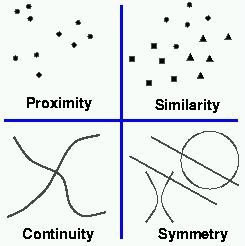
visual perception must be viewed as an active process by which the visual information is interpreted and grouped according to a large number of rules. These Gestalt laws allow a phenomenological interpretation of the interactions between visual features that lead to the perception of composite objects. These laws are given below:
Laws of Perceptual Organization

(i) Good Form (Law of Pragnanz): This law states that perceptual organization will always be as “good” as the prevailing conditions allow. The simplest organization requiring the least cognitive effort will always emerge. Pragnanz means that we perceive the simplest organization that fits the stimulus pattern.


(ii) Proximity: All the stimuli that occur together in space or time will be organized together.


(iii) Similarity: Other things being equal, elements which are similar in structure or have common characteristics will be grouped together.


(iv) Closure: An incomplete figure will be seen as a complete one. a figure consisting of incomplete lines, that have gap in them. It is perceived as a triangle despite the fact that its sides are incomplete. A closure like phenomenon yields subjective contours.


AS ELEMENTS OF OUTER LAYER OF CONSCIOUSNESS


Success in performing art therapy depends upon its act on outer, inner and innercore layer of consciousness. The three layers of consciousness is given in Figure 1.


Figure 1 Layers of consciousness

Through performing art, one can start journey from outer to innercore layer through inner layer. Figure 2 shows the journey by Rabindrasangeet.

Faulty or poor development of outer layer inhibits this journey.


Figure 2 Rabindrasangeet is a journey across layers of consciousness.

Outer layer of consciousness concerns attention, sensation and perception. Any abnormality in these three causes serious problem in formation of inner and inner core layers of consciousness as these three play critical role in information processing model (Figure 3) specially in relation to filtering stimuli, retaining in memory stores and in developing imagery processes.


Figure 3. The Information Processing Model of Memory (Based on Atkinson and Shiffrin, 1968)
[Ref. Stevens Handbook of Experimental Psychology (2002) 3rd Edition, Volume 2: ‘Memory and Cognitive Processes’. John Wiley & Sons, Inc.; pp 10].

This multi store memory model is later expanded upon by Baddeley and other co-workers and has become the dominant view in the field of working memory (Figure 4).
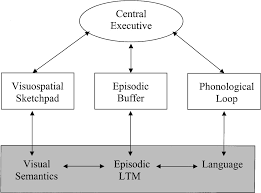
Figure 4 Baddley's working memory model

The original model of Baddeley & Hitch was composed of three main components; thecentral executive which acts as supervisory system and controls the flow of information from and to its slave systems: the phonological loop and the visuo-spatial sketchpad. The slave systems are short-term storage systems dedicated to a content domain (verbal and visuo-spatial, respectively). In 2000 Baddeley added a third slave system to his model, the episodic buffer. This component is a third slave system, dedicated to linking information across domains to form integrated units of visual, spatial, and verbal information with time sequencing (or chronological ordering), such as the memory of a story or a movie scene. The episodic buffer is also assumed to have links to long-term memory and semantical meaning.

ABNORMALITIES & PERFORMING ART THERAPY

Faulty development of outer layer creates mental illness due to inability to learn. Therefore, attention should be paid to these three processes in order to understand functional efficacy of the outer layer. ADHD or AD, Mentally challenged or mentally retarded children, HIV and Schizophrenic patients suffer from poor organizing functions of outer layer of consciousness.

ADHD or AD: Attention deficit hyperactivity disorder (ADHD or AD/HD or ADD) is a neurobehavioral developmental disorder. It is primarily characterized by "the co-existence of attentional problems and hyperactivity, with each behavior occurring infrequently alone" and symptoms starting before seven years of age. Function and outcome of Autism spectrum disorders (ASD) are affected not only by core deficits but by frequently associated comorbid behaviors- such as irritability, sensory abnormalities, hyperactivity, affective disorders and others. Outcome is further affected by the presence or absence of language and by overall cognitive ability. Robert Sears, M.D., discussed top 7 therapies for autism in his recently published book. To him, “Every child with autism is unique, and so each therapy program should be individualized to meet his or her needs,”. The 7 therapies are (i) Applied Behaviour Analysis (ABA), (ii) Relationship based floor-time therapy, (iii) Functional communication training, (iv) Language therapy, (v) Picture exchange communication system, (vi) Occupational therapy (viii) Treatment and Education of Autistic and Related Communication-Handicapped Children or TEACCH. In another experiment, it is noted that by using Rabindrik dance to one child diagnosed as autistic by NIMHANS., Bangalore, attentive behaviour is controlled. One performing art therapist was asked to train the child Rabindrik dance " Phule phule dhole dhole". The autistic boy initially could not attend to eye movement but he gradually followed each eye and posture movement of the therapist and finally was able to coordinate eye and posture movement keeping in tune of the music. This suggests that one can control outer layer of consciousness by performing art with patience and hierarchical structuring of the dance movement. In this experiment, therapist had used classical conditioning and patting, hugging, verbal reinforcements were the reinforcements.


Mentally challenged or Mentally retarded: In case of mentally challenged or mental retardation, problem is related to impaired cognitive functioning and deficits in adaptive behaviour. Usually their IQ and SQ are below 70 using standard intelligence test and adaptive behaviour test like Vineland Social Maturity scale. Below are the ranges of IQ and corresponding classification of mentally disorder.

Profound mental retardation: Below 20
Severe mental retardation: 20–34
Moderate mental retardation: 35–49
Mild mental retardation: 50–69
Borderline intellectual functioning: 70–84

To provide performing art therapy to mentally retarded children, it is important to follow different principles of behaviour modification technique like shaping, token economy etc.

HIV: Human immunodeficiency virus (HIV) infection is associated with an increased risk for human herpes viruses (HHVs) and their related diseases and they frequently cause disease deterioration and therapeutic failures. Cognitive impairments are one of the major consequences of HIV infection in the human body – as the virus, once in the blood stream, can cause significant damage to the brain. Further, it makes the body vulnerable to a host of opportunistic infections – infections that would not normally affect a person with a healthy immune system (“AIDSmeds”, 2009). Many of these have significant impact on brain functioning.

1. In the early stages the disorder is characterized by minimal cognitive and motor impairments as shown by slowed information processing and slowed extremity movements. The patient can function on his own with minimal assistance such as reminders.

2. As the disease progresses, there is functional cognitive, affective and motor impairment. The patient misplaces things, faces difficulty in performing complex tasks and has problems with verbal memory and new learning. There may be motor dysfunctions like tremors, leg weakness and loss of balance. The patient may become ambulatory, but may be able to perform the basic activities of self-care.

3. With further neurodegeneration, the subcortical dementia begins to resemble global cortical dementia. At this point, there is deterioration of intellectual function, decision making capacity, delirium, hallucinations and loss of behavioural control. The patient cannot walk unassisted, there is considerable slowing of all cognitive faculties (including speech and reaction time), and there may be affective symptoms like apathy, irritability and social withdrawal.

4. The end stage, marking full progress of the syndrome, is characterized by a nearly vegetative state, with rudimentary levels of intellectual and social comprehension and bladder incontinence.

Schizophrenia: Schizophrenia affects approximately 1% of the population worldwide and is a chronic, severe psychiatric disorder. The onset of schizophrenia usually occurs around 18-25 years of age and is often preceded by premorbid behavioral deviations, such as social withdrawal and affective changes (Keshavan et al., 2005). Psychiatrist Emil Kraepelin, was the first to acknowledge psychiatric disorders from a biological perspective, and established the term dementia praecox. In 1911, the Swiss psychiatrist Paul Eugen Bleuler renamed dementia praecox as “the group of schizophrenias” and described it as a cluster of disorders rather than one coherent disease. With reference to prognosis, Crow (1980) classified two categories – type I and type II. Type I schizophrenia patients are those who present, often more acutely, with a predominantly positive symptom profile and who have a good response to neuroleptics or antipsychotics. In contrast, type II schizophrenia patients are those who have a more chronic illness, more frequent evidence of intellectual impairment and enlarged ventricular size and cortical atrophy as seen on CT or MRI scans, a poorer response to neuroleptics and predominantly negative symptoms. Type I category of patients possessed symptoms which are excess or distortion of normal mental functions like hearing voices, so these symptoms are called as positive symptoms. And Type II category patients possess symptoms which are loss or reduction of normal functioning like asocial behavior. These are called negative symptoms. Diagnostic Statistical Manual (DSM-IV-TR) accepts this classification. Of the two types, the negative symptoms are more difficult to evaluate because they may be influenced by a concurrent depression or a dull and un-stimulating environment, but they account for much of the morbidity (unhealthiness) associated with schizophrenia. The positive symptoms associated with better prognosis as compared to negative symptoms.

Positive Symptoms: The positive symptoms of schizophrenia include four "first-rank" or Schneiderian symptoms, named for a German psychiatrist who identified them in 1959 and other positive symptoms.


Ref: http://www.nios.ac.in/srsec328newE/328EL5.pdf


Dutta Roy,D.(2006). Development of picture drawing test to assess consciousness layers of tribal children of Tripura, Journal of the Indian Academy of Applied Psychology,Vol. 32, No. 1, 20-25

Wednesday, December 22, 2010

Scope of Psychology in performing art therapy

Dr. D. Dutta Roy, Ph.D.(Psy.) LECTURE NOTES ON SCOPE OF PSYCHOLOGY IN PERFORMING ART THERAPY PERFORMING ART THERAPY CENTRE RABINDRABHARATI UNIVERSITY KOLKATA

Performing art therapy is the set of therapeautic procedures where in music, songs and drama are systematically applied to achieve therapeautic goals of symptom relief, emotional and physical integration and personal growth. It helps the client tell his or her story to solve a problem, achieve a cathersis, extend the depth and breadth of inner experience, understand the meaning of images, and strengthen the ability to observe personal roles while increasing flexibility between roles. Performing art therapy includes improvisation, role playing, pantomime, puppetry, mask work, and theatrical production. It would be misnomer to assume that specific drama or music or songs are appropriate for specific type of complaints.

Knowledge about principles of Psychology helps therapist to understand individual differences in effectiveness of therapy. Effectiveness means improvement in the general functioning of patients, amelioration of disorders and relief of specific presenting symptoms.

Psychology

In earlier times, Psychology refers to science of psyche or of mind. Later it is called as a science of behaviour. Former concept fails to prove empirical existence. Later focuses on relationship between physiological(cortical and endocrinal) and psychological functions through empirical researches. Behaviour is the interaction of two things as P (individual characteristics) and Environment (the surroundings). The formula is B=f(P X E). Individual characteristics include three broad functions as cognitive, affective and conative.


  • Cognitive funtions include sensation, perception, attention, memory, thinking, learning;
  • Affective functions include feeling and emotion;
  • Conative functions include Psycho-motor coordination.
  • Another complex characteristic is personality. Psychologists are analyzing elements of each function along with it's changes across stages of development or in different environmental conditions. Their main aim is to find out pattern of individual differences in behavior so that change in behaviour can be predicted and controlled. To study individual differences in behaviour, three methods are followed as introspective,observation and experimental methods. It provides sets of theories and assessment techniques which are important to Performing art therapist for eliciting desired and controling undesired behaviour . For example, principles of classical and operant conditioning help performing art therapist to control behaviour by manipulation of conditioned stimulus. The areas on which performing art therapist should be concerned with are:

    1. Sensation: Awareness of stimulus is called sensation. Theories of sensation include attributes and measurement of sensations, determining threshold and functions of sensory organs.
    2. Perception: The meaning of sensation is perception. Theories of perception include perceptual organization or laws of perception, principles of distance and depth perception, illusion and hallucination.
    3. Attention: Focus of awareness is attention. Theories of attention are factors influencing attention, fluctuation and distraction.
    4. Memory: It is the process of remembering. Theories are short and long term memory, working memory etc.
    5. Learning: It is the modification of behaviour through practice and experiences. Theories are classical and operant conditioning, trial and error, gestalt learning.
    6. Thinking: Theories are related to concept formation, imagery etc.
    7. Child development: Characteristics and determinants of development - Heredity and Environment, Brain localization and behaviour, Physical development, Language development, Emotional development, Intellectual development, Social development, Personality development.
    8. Personality: It is the dynamic organization of those psychophysical systems that determine one's unique adjustment with environment. Theories of personality include Characteristics of personality, Psychodynamic theories of personality, Adler and Bandura’s model of personality.
    9. Mental health: Principles of mental health. Models of adjustment and maladjustment, Characteristics of positive mental health, Frustration and types of conflict.
    10. Psychotherapy: The intervention process to control psychological abnormalities using theories of Psychology. It includes psychoanalytic therapy, Behaviour modification, cognitive behaviour therapy, existential therapy.
  • Tuesday, December 21, 2010

    Gestalt Learning

    Gestalt means whole. We perceive everything as whole not as sum of parts.
    The three main Gestalt theorists were Wertheimer, Kohler, and Koffka.

    Kohler's experiment


    Wertheimer'PHI phenomenon


    he phi phenomenon is a perceptual illusion described by Max Wertheimer in his 1912 Experimental Studies on the Seeing of Motion, in which a disembodied perception of motion is produced by a succession of still images. In discussions of the perception of film and video it is often confused with beta movement, but it is a distinct phenomenon not directly involved in the perception of motion pictures.
    The classic phi phenomenon experiment involves a viewer or audience watching a screen, upon which the experimenter projects two images in succession. The first image depicts a line on the left side of the frame. The second image depicts a line on the right side of the frame. The images may be shown quickly, in rapid succession, or each frame may be given several seconds of viewing time. Once both images have been projected, the experimenter asks the viewer or audience to describe what they saw.
    At certain combinations of spacing and timing of the two images, a viewer will report a sensation of motion in the space between and around the two lines, even though the viewer also perceives two distinct lines and not the continuous motion of objects referred to as Beta movement. The phi phenomenon looks like a moving zone or cloud of background color surrounding the flashing objects. The discovery of the phi phenomenon was a significant milestone in Gestalt psychology.


    In the phi phenomenon, a succession of still images with an omission gives the illusion of movement. The phi phenomenon always takes the background color.[1] In this Lilac chaser illusion, the omitted space appears to be filled with a green circle when viewed long enough.

    Koffka's ideation learning


    A "Gestalt" is an integrated whole system with it's parts enmeshed. The whole is greater than just the sum of the parts.

    The "PHI" phenomenon described a characteristic of things wherein they have a recognizability inherent in their nature. Examples include the recognizability of a melody, no matter how it is arranged or what instrument plays it, or the recognizability of a letter rendered in a wide variety of different fonts or type styles. Other examples include the apparent motion created by a rapid sequence of stills in motion pictures, and the sequences of illminating elements in neon signs which give the illusion of movement. Visual and auditory examples are numerous. This phenomenon leads to the conclusion that elements sensed are not the only reality.

    "Phenomenology" is the acceptance of first hand experience as it is found in human consciousness.

    Gestalt Learning Theory proposed several laws of organization, which are innate ways that human beings organized perceptions. A gestalt factor is a condition that aids in perceiving situations as a whole or totality. Isomorphism refers to the Doctrine of Psychophysical parallelism and depicts the cerebral cortex as "mapping these gestalt fields of stimuli.

    The Factor of Closure suggests that perception tends to complete incomplete objects. When only part of an image, sound, thought or feeling is presented as a stimulus, the brain attempts to complete it to generate the whole.

    The Factor of Proximity suggests that when elements are grouped closely together, they are percieved as wholes. This has relevance in reading, visual arts, and music.

    The Factor of Similarity proposes that like parts tend to be grouped together in cognition. This has implications for instruction, suggesting that learning is facilitated if similar ideas are treated and linked together and then contrasted with opposing or complementary sets of ideas.

    The Figure-Ground Effect suggests that the eye tends to see the objects, rather than the spaces or holes between them.

    Monday, December 20, 2010

    E.L.Thorndike's LAWS OF LEARNING

    TRIAL AND ERROR THEORY OF LEARNING
    LECTURE NOTE
    PERFORMING ART THERAPY CENTRE
    RABINDRABHARATI UNIVERSITY
    KOLKATA


    Psychologist Edward L. Thorndike (1874-1949) proposed this theory through his experiment on animal in the wooden box.

    EXPERIMENT


    The animal (often a cat) is put into a box and tries to find its way out.
    o The box consists of ropes, levers, and latches that the animal could use as a means of escape.
    o Once the cat escapes, a reward is given.
    o Thorndike through his observation realized that after time, the cat would use a trial and error technique.
    o Thorndike also realized that with more trials the less time it took the cat to escape.
    o Thorndike concluded that the cat learned through trial and error as do humans in similar circumstances.

    LAWS OF LEARNING

    Based on above experiment,Thorndike suggested three laws of learning:

    1. Law of effect: It states that responses which occur just
    prior to a satisfying state of affairs are more likely to be repeated, and responses just prior to an annoying state of affairs are more likely not to be repeated.

    2. Law of Exercise - connections become strengthened with practice, and weaken when practice is discontinued.

    3. Law of Exercise - connections become strengthened with practice, and weaken when practice is discontinued.

    4. Law of Exercise - connections become strengthened with practice, and weaken when practice is discontinued.

    5. Other laws:

    5.1. Multiple Response: in any given situation, the organism will respond in a variety of ways if the first response does not immediately lead to a more satisfying state of affairs. Problem solving is through trial and error.
    5.2. Set or Attitude: there are predisposition's to behave or react in a particular way. These are unique for species or groups of related species, and may be culturally determined in humans.
    5.3. Prepotency of Elements- Thorndike observed that a learner could filter out irrelevant aspects of a situation and respond only to significant (proponent) elements in a problem situation.
    5.4. Response by Analogy -In a new context, responses from related or similar contexts may be transferred to the new context. This is sometimes referred to as the theory of identical elements.
    5.5. Associative shifting - It is possible to shift any response from one stimulus to another.
    5.6. Law of Readiness- a series of responses can be chained together to satisfy some goal which will result in annoyance if blocked.

    CRITICISM
    The major criticism of Thorndike’s behaviorist theories may be summarized in two points. First, Thorndike’s approach restricted psychology by limiting behavior solely to the peripheral events of stimulus and response elements. In dismissing mental events, Thorndike also ignored the central mediation of stimulus and response bonds.

    The second problem with Thorndike’s behaviorist theories concerns the issue of reductionism. In fact, for Thorndike, mind was reduced to behavior, and behavior, in turn, was reduced to environmental stimuli and observable responses.

    APPLICATION IN PERFORMING ART THERAPY

    In performaing art therapy for child having low intelligence, therapist can apply above four laws in systematic intervention like Applied Behaviour Analysis. Besides, above laws can be applied in therapeautic intervention of severe psychiatric disorders.

    =====================================================================================

    INTELLIGENCE

    To him, intelligence is a function of the number of connections made.Thorndike characterized the two most basic intelligences as Trial-and-Error and Stimulus-Response Association.

    Thorndike and his students used objective measurements of intelligence on human subjects as early as 1903. By the time the United States entered WWI, Thorndike had developed methods for measuring a wide variety of abilities and achievements.

    During the 1920's he developed a test of intelligence that consisted of completion, arithmetic, vocabulary, and directions test, known as the CAVD. This instrument was intended to measure intellectual level on an absolute scale. The logic underlying the test predicted elements of test design that eventually became the foundation of modern intelligence tests.

    Thorndike drew an important distinction among three broad classes of intellectual functioning. Standard intelligence tests measured only "abstract intelligence". Also important were "mechanical intelligence - the ability to visualize relationships among objects and understand how the physical world worked", and social intelligence - the ability to function successfully in interpersonal situations". Thorndike called for instruments to develop measures for these other types of intellect.

    Thorndike developed psychological connectionism. He believed that through experience neural bonds or connections were formed between perceived stimuli and emitted responses; therefore, intellect facilitated the formation of the neural bonds. People of higher intellect could form more bonds and form them more easily than people of lower ability. The ability to form bonds was rooted in genetic potential through the genes' influence on the structure of the brain, but the content of intellect was a function of experience. Thorndike rejected the idea that a measure of intelligence independent of cultural background was possible.

    Thorndike proposed that there were four general dimensions of abstract intelligence:

    Altitude: the complexity or difficulty of tasks one can perform (most important)
    Width: the variety of tasks of a give difficulty
    Area: a function of width and altitude
    Speed: the number of tasks one can complete in a given time .
    His intellectual development of this multi-factored approach to intelligence contributed to a great debate with Charles Spearman (Spearman proposed a single, general intelligence factor 'g') that encompassed twenty five years.

    Publications

    Educational Psychology (1903)
    Introduction to the Theory of Mental and Social Measurements (1904)
    The Elements of Psychology (1905)
    Animal Intelligence (1911)
    The Measurement of Intelligence (1927)
    The Fundamentals of Learning (1932)
    The Psychology of Wants, Interests, and Attitudes (1935)
    References: 5, 8, 14, 21, 28, 17

    ==================================================================================

    Tuesday, December 14, 2010

    Pavlov's classical conditioning

    Pavlov's classical conditioning theory:

    Classical conditioning is a reflexive or automatic type of learning in which a stimulus acquires the capacity to evoke a response that was originally evoked by another stimulus.
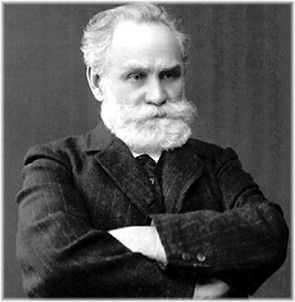
    Originators and Key Contributors: First described by Ivan Pavlov (1849-1936), Russian physiologist, in 1903, and studied in infants by John B. Watson (1878-1958).

    Pavlov's experiment


    pavlov classical conditioning


    Summary

    • Classical conditioning occurs when a previously neutral stimulus causes a reflex.

    • Ivan Pavlov is most famous for his work on dogs and classical conditioning.

    • The unconditioned stimulus causes an automatic reflex response without prior learning (e.g. food in mouth causes salivation).

    • The conditioned stimulus is created by learning, whereby a stimulus becomes associated with something else (e.g. dog associates bell with food, and ringing bell causes dog to salivate).

    • The unconditioned reflex is a reflex that happens automatically (e.g. salivation is an unconditioned reflex, because it happens automatically when you put food in your mouth).

    • The conditioned reflex is a learnt response pattern (e.g. dog salivating to sound of bell).

    • Conditioning takes place automatically and without you having to think about it, and the conditioned reflexes are involuntary.

    • Extinction occurs when you unlearn something, such as unlearning that the bell means food and no longer salivating in response to it.

    • Stimulus Generalisation occurs when a new but similar stimulus to your original conditioned stimulus, still results in the conditioned reflex (e.g. similar sounding bell still makes dogs salivate).

    • Discrimination occurs when a new stimulus is too dissimilar from your original conditioned stimulus to cause the conditioned reflex (e.g. different sounding bell no longer makes dogs salivate).

    Sources:
    Ref: http://www.eruptingmind.com/pavlov-classical-conditioning-theory/
    http://www.learning-theories.com/

    Operant Conditioning

    OPERANT CONDITIONING


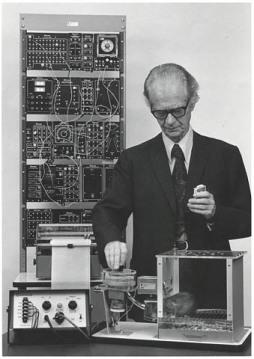
    B.F. Skinner (1904-1990)


    Operant conditioning follows following principles:

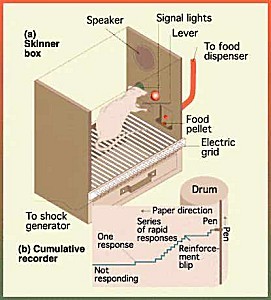
    1. The organism is in the process of “operating” on the environment. During this “operating,” the organism encounters a special kind of stimulus, called a reinforcing stimulus, or simply a reinforcer. This special stimulus has the effect of increasing the operant -- that is, the behavior occurring just before the reinforcer. This is operant conditioning: “the behavior is followed by a consequence, and the nature of the consequence modifies the organisms tendency to repeat the behavior in the future.”

    2. A behavior followed by a reinforcing stimulus results in an increased probability of that behavior occurring in the future.

    3. A behavior no longer followed by the reinforcing stimulus results in a decreased probability of that behavior occurring in the future.

    4. Schedules of reinforcement
    Changes in behaviour occur by the different schedules of reinforcement. The two schedules are interval and ratio.

    Continuous reinforcement is the original scenario: Every time that the rat does the behavior (such as pedal-pushing), he gets a rat goodie.

    The fixed ratio schedule was the first one Skinner discovered: If the rat presses the pedal three times, say, he gets a goodie. Or five times. Or twenty times. Or “x” times. There is a fixed ratio between behaviors and reinforcers: 3 to 1, 5 to 1, 20 to 1, etc. This is a little like “piece rate” in the clothing manufacturing industry: You get paid so much for so many shirts.

    The fixed interval schedule uses a timing device of some sort. If the rat presses the bar at least once during a particular stretch of time (say 20 seconds), then he gets a goodie. If he fails to do so, he doesn’t get a goodie. But even if he hits that bar a hundred times during that 20 seconds, he still only gets one goodie! One strange thing that happens is that the rats tend to “pace” themselves: They slow down the rate of their behavior right after the reinforcer, and speed up when the time for it gets close.

    Skinner also looked at variable schedules. Variable ratio means you change the “x” each time -- first it takes 3 presses to get a goodie, then 10, then 1, then 7 and so on. Variable interval means you keep changing the time period -- first 20 seconds, then 5, then 35, then 10 and so on.

    5. Shaping: It is the method of successive approximations.” Basically, it involves first reinforcing a behavior only vaguely similar to the one desired. Once that is established, you look out for variations that come a little closer to what you want, and so on, until you have the animal performing a behavior that would never show up in ordinary life. Skinner and his students have been quite successful in teaching simple animals to do some quite extraordinary things. My favorite is teaching pigeons to bowl!

    6. Aversive stimuli

    An aversive stimulus is the opposite of a reinforcing stimulus, something we might find unpleasant or painful.

    A behavior followed by an aversive stimulus results in a decreased probability of the behavior occurring in the future.

    Behavior followed by the removal of an aversive stimulus results in an increased probability of that behavior occurring in the future.