What is Psychological operations (PSYOP) ?
Psychological
Operations or PSYOP are planned operations to convey selected information and
indicators to audiences to influence their emotions, motives, objective
reasoning, and ultimately the behavior of organizations, groups, and
individuals.
Why is it important ?
PSYOP is important to weaken the enemy psychologically and to capture the heart of civilians of enemy country. Interestingly, there is no loss of bullets but national objectives can be met.
"Psychological operations...have proven to be indispensable...it allowed
us to apply a type of power without necessarily having to shoot bullets.
Colonel Andy Birdy, Commander, (1st Brigade Combat Team,10th Mountain Division,
during Operation UPHOLD DEMOCRACY in Haiti)."
Is PSYOP necessary for war only ?
No, PSYOP can be provided before, during and after the war. PSYOP is oriented to both military and civilians. PSYOP acts as security during no war and operations to achieve national objectives.
Is there any PSYOP soldier ?
PSYOP is part and parcel of the warfare ? Psyop soldiers influence the emotions, motives, reasoning and ultimately the behaviour of foreign country. They affect and reinforce foreign attitudes and behaviour favourable to the objectives. They shape the civil environment and set the conditions for military operations by mitigating or defeating threats to civil society working directly with local populations, intergovernmental and nongovernmental organizations. US maintains PSYOP soldiers.
How does PSYOP act ?
PSYOP forces primarily conduct operations at the operational and
tactical levels of war, and during military operations other than war
(MOOTW). PSYOP forces also support strategic operations.
a) At the
operational level, they support combatant commanders and commanders,
joint task forces (CJTFs).
b) At the tactical level, PSYOP forces support
conventional forces and special operations forces (SOF).
c) PSYOP units can
conduct strategic activities in support of the President and/or Secretary of
Defense (SecDef) and the Chairman of the Joint Chiefs of Staff (CJCS), when
directed. PSYOP are inherently joint, frequently combined, and must be
integrated and synchronized at all echelons to achieve their full force multiplier
potential.
What are the roles of PSYOP soldier ?
PSYOP Soldiers can perform following five roles:
• Influence foreign populations by expressing information subjectively to
influence attitudes and behavior, and to obtain compliance,
noninterference, or other desired behavioral changes. These actions
facilitate military operations, minimize needless loss of life and
collateral damage,
• Advise the commander on enabling actions, and
targeting restrictions that the military force may execute. These
actions and restrictions minimize adverse impacts and unintended
consequences, attack the enemy’s will to resist, and enhance successful
mission accomplishment.
PSYOP Soldiers also advise the commander
on the psychological effects and consequences of other planned
military actions and operations.
• Provide public information to foreign populations to support
humanitarian activities, restore or reinforce legitimacy, ease suffering,
and maintain or restore civil order. Providing public information
supports and amplifies the effects of other capabilities and activities
such as civil-military operations (CMO).
• Serve as the supported commander’s voice to foreign populations to
convey intent and establish credibility. This ability allows the
commander to reach more audiences with less expenditure in
resources and time.
• Counter enemy propaganda, misinformation, disinformation, and
opposing information.
Is PSYOP important for border security forces or state police?
Border security forces and State police at the border areas are affected by migration. Migration refers to "the movement of people from one place to another".
There are two main types of migration: first, internal
migration, i.e. migration within one country, and secondly
international migration, which means the movement from one
country to another.
A good example of internal migration is the movement from
Bihar to West Bengal and a good example of international migration is from Bangladesh to West Bengal or from Pakistan to India.
Migration is caused by "push" and "pull" factors.
Push factors are those in their old place which force people
to move. For example, there may be civil wars or wars in
general in the country, but political or religious oppression,
climate changes, lack of jobs or simply poverty are all
important push factors.
Pull factors are factors in the target country which encourage
people to move; these include peace and safety, a chance of
a better job, better education, social security, a better
standard of living in general as well as political and religious
freedom.
Migration factors:
The first migrations from Bihar date back to 1834. Every second family in the state today is sustained by migrant workers who form the backbone of the country's workforce. But in 2008, thousands of Biharis found themselves forced to return from Maharashtra following the Maharashtra Navnirman Sena's sons-of-the-soil campaign. After decades selling bhelpuri on Mumbai's Chowpatty or working as construction labour, Bihar's migrants were shocked to find themselves treated like outsiders in their own land.
Paswan said his village in Samastipur typifies the situation in the state, surrounded by poverty, filth and violence. "It has no road, no electricity, no education, no health facilities," he said. Like most young men of the village, Paswan migrated to Mumbai at the first opportunity, in 1998. He chose to become a migrant like hundreds of others in his village of a few thousands.
PSYOP should study human development indicators for predicting migration:
The report indicates that Bihar lags behind other states on all the development indices. It was ranked at the bottom in the Human Development Indicator (HDI), which was about 20% lower than the national HDI.
With an estimated population of 90.2 million (83 million, according to the 2001 census), 536.91 lakh people live below the poverty line in Bihar. No wonder the Bihar government's claim of economic achievement, with the Gross Domestic Product (GDP) growth rate stated to be 16%, drew flak from many economists in the state who questioned the very rationale of the economic survey.
The economists point out that the state's claims cannot be true when Bihar, an agrarian state, recorded a drastic fall in foodgrain output, power generation was almost negligible, and industrial growth barely touched 5.5% compared with the national rate of 20.1%.
"Low wages combined with employment uncertainty, lack of educational institutions combined with lack of industry, and absence of market and investment opportunities means the Bihari migrants, whether educated or not, and their progeny, cannot come back, even if they want to," said Srikant, who believes that the well-established internal migration chain that pushes millions of people from Bihar to all parts of India in search of a livelihood is unlikely to halt due to the recent events in Maharashtra.
Ref: http://infochangeindia.org/agenda/migration-a-displacement/the-original-migrants.html
There are some other factors that influence migration.
Simultaneously in rural India, deep agricultural transformations are taking place, altering the landscape, the available opportunities, and ultimately the livelihoods of its people.
Function of PSYOPS
Simultaneously in rural India, deep agricultural transformations are taking place, altering the landscape, the available opportunities, and ultimately the livelihoods of its people.
Does mass communication help in PSYOP ?
Both one-window and multi-window wise mass communication systems are used in PSYOP. Mass communication is the study of how individuals and entities relay information through mass media to large segments of the population at the same time. It is usually understood to relate to newspaper, magazine , and book publishing, as well as radio , television and film, as these mediums are used for disseminating information, news and advertising . Mass communication differs from the studies of other forms of communication, such as interpersonal
communication or organizational communication , in that it focuses on a single source transmitting information to a large group of receivers. The study of mass communication is chiefly concerned with how the content of mass communication persuades or otherwise affects the behavior, attitude , opinion, or emotion of the person or people receiving the information.
What are the tools of PSYOP ?
Besides mass communication, other systems like leaflets, hoardings, rumours and propaganda are used.
What is propaganda ?
Ideas or statements that are often false or exaggerated
and that are spread in order to help a cause, a political
leader, a government, etc.
Is propaganda structured?
Propaganda is structured in a systematic way. Edward S Herman and Noam Chomsky suggested propaganda Theory. The theory postulates five general classes of "filters" that determine the type of news that is presented in news media. These five classes are: Ownership of the medium, Medium's funding sources, Sourcing,
Flak,
fear ideology.
Ownership: Government
Media should focus on news of "the Prime Minister's personal spokesperson" for government news. Business corporations and trade organizations are also trusted sources of stories considered newsworthy.
Web:
About propaganda leaflets:
http://www.paperlessarchives.com/korean_war_propaganda_leaflets.html
History of PSYOP:
http://www.psywarrior.com/psyhist.html
Conceptual overview:
file:///C:/Users/DDROY/Downloads/strategicanalysis_snarula_0304.pdf
Ref: https://fas.org/irp/doddir/army/fm3-05-30.pdf
Psychological field management: Psychological fields are not the manifested but
latent contents of human mind. It includes emotions, perception, attitude, belief,
reasoning.and personality. This can be understood through force field management.
Force field management: Force Field Analysis was developed by Kurt Lewin (1951) and is widely used in decision making, particularly in planning and implementing change management programmes. It is a powerful method of gaining a comprehensive overview of the different forces acting on a potential organisational change issue, and for assessing their source and strength. Combat or war situation is dynamic and it is affected by different driving and restraining forces. Lewin assumes that strategic decisions are determined by driving movement toward a goal (helping forces) or blocking movement toward a goal (hindering forces). Strategic decisions make the life space or group equilibrium. Equilibrium occurs when particular forces are held in balance by the interaction of two opposing forces.
Above picture shows two opposite forces are acting in order to make equilibrium state.
Strength of the forces are different.
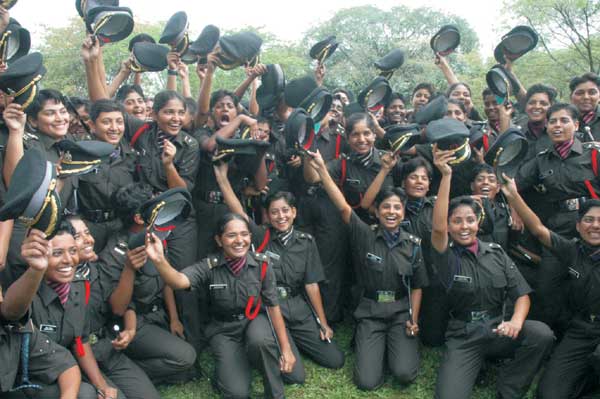
Force field analysis in Army career (Individual level)

Driving forces
 |
| Achievement |
Restraining forces:
 |
| Integrating with sophisticated weapon |
 |
Long hours of work
http://www.psicopolis.com/kurt/lewinsintesi.htm
|